 BabyTides™
Join the waitlist
Health · 0–12 months
Cradle cap: what it is, what helps and when to call
What the American Academy of Pediatrics (AAP), the NHS and MedlinePlus say about cradle cap: how common it is, how long it lasts, the scalp care they describe, where their advice differs, and which signs mean it's time to call. This article summarizes guidance from health organizations and published research; it isn't personal medical advice.
Quick answers
Does cradle cap go away on its own?
The NHS says it usually goes away on its own within a few months [2]. The AAP says it usually clears by itself within weeks or months, and has usually gone by age 1, though some toddlers still have some flaky buildup [1].
Can I use oil on cradle cap?
The sources differ. For stubborn scales, the AAP mentions a little mineral oil, coconut oil or petroleum jelly left on overnight [1]. The NHS mentions an emollient (moisturizer) or coconut oil, and says not to use olive oil or peanut oil [2]. More on this below.
Should I pick off the flakes?
No. Both the AAP and the NHS say not to pick at the scales or crusts, because it raises the risk of infection [1, 2].
BabyTides app · coming to iPhone and Android
Keep a simple record for your pediatrician
Log temperatures, feeds, diapers and notes in a few taps. Look back at the days together if you need to call.

- Temperatures
- Notes
- Weekly summary
Want paper for now? Print our free newborn log, no sign-up needed.
Not in the App Store or Google Play yet. We’ll email you when it opens.
What cradle cap is
The AAP describes cradle cap as an oily, scaly rash on a baby's scalp and says it is a type of seborrheic dermatitis [1]. The NHS calls it a common, harmless skin condition in babies [2].
According to the NHS, it shows up as greasy, scaly patches, mostly on the scalp and face, and sometimes in the diaper area or skin creases [2]. The scales can be white or yellow and can form a crust that may flake off [2]. The NHS notes that the scales look much the same whatever the baby's skin tone, while the skin underneath may look pink or red on white skin, or lighter or darker than the skin around it on brown or black skin [2]. MedlinePlus describes thick, crusty yellow or brown scales and says they can also appear on the eyelids, ears and around the nose [3].
The AAP says the same rash can show up on the face, armpits, neck creases and diaper area, where it's called seborrheic dermatitis [1]. For rashes that start in the diaper area, see diaper rash: causes, care and when to call.
On the cause, the NHS says it isn't clear [2]. The AAP says the cause is unknown and mentions two theories: a reaction to a common yeast that lives on everyone's skin, or the mother's hormones making the baby's oil glands overproduce [1]. The AAP says it isn't caused by allergy, infection or poor hygiene [1]. MedlinePlus also says it isn't caused by poor hygiene and isn't an allergy [3].
The AAP says cradle cap is rarely itchy or uncomfortable and isn't contagious [1]. The NHS says it isn't itchy or painful, doesn't bother the baby, and can't be caught from other babies [2].
How common it is and how long it lasts
The AAP says cradle cap usually starts between three weeks and two months after birth, and that 70% of three-month-olds have it [1].
A 2003 survey in Archives of Dermatology examined 1,116 children under 6 years old in Victoria, Australia [5]. The authors found seborrheic dermatitis in about 10% of the children, most often in the first three months of life, and scalp scaling, which they also call cradle cap, in about 42% [5]. Most cases of both were minimal or mild [5].
On how long it lasts, MedlinePlus says cradle cap often clears within a few months but can last until age 2 or 3 [3]. The AAP and NHS time frames are in the quick answers above.
Scalp care the guidance describes
The AAP says cradle cap doesn't need treatment, but describes ways to help loosen the scales [1]:
- Wash your baby's hair about every other day, which the AAP says helps most babies. For babies with another skin condition, the AAP suggests checking with a pediatrician or dermatologist about how often to bathe [1].
- Use a mild baby shampoo, and check with your pediatrician before using a medicated shampoo, which the AAP says may irritate a baby's skin [1].
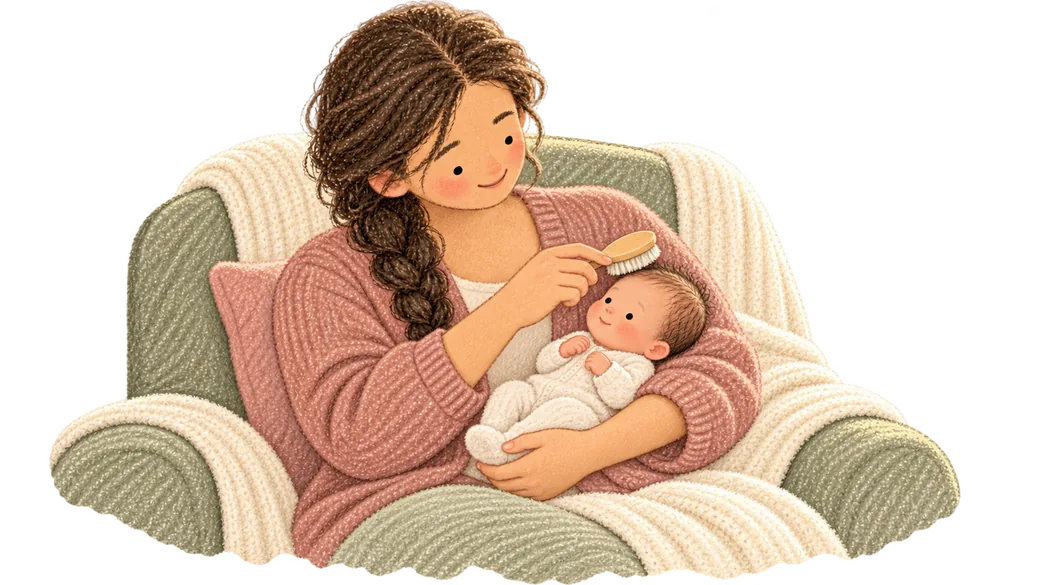
- Loosen the scales by gently massaging the scalp, brushing with a soft brush or using a baby comb [1].
- For stubborn scales, put on a little mineral oil, coconut oil or petroleum jelly and let it sit overnight, then wash and brush as usual [1].
The NHS lists these steps [2]:
- Gently massage an emollient (moisturizer) or coconut oil into the scalp to loosen the scales [2].
- Brush the scalp gently with a soft brush and then wash with baby shampoo [2].
- If scales appear elsewhere on the body, wash your baby regularly with water and an emollient rather than soap [2].
- Change wet or dirty diapers as soon as you can, and if scales are in the diaper area, use a barrier cream to protect the skin [2].
The NHS also lists things not to do: don't use olive oil, which it says may not be suitable for skin, or peanut oil, because of the allergy risk; don't use soap, adult shampoos, or products with fragrance or perfume; and don't pick the crusts [2]. The NHS says a pharmacist can advise on a scalp emollient, unperfumed baby shampoo, and barrier cream for the diaper area [2].
MedlinePlus says most cases can be managed at home, and describes gentle scalp massage with fingers or a soft brush, daily, gentle shampooing with a mild shampoo while scales are present, and twice weekly once they're gone [3]. If the scales won't loosen, it describes rubbing mineral oil into the scalp and wrapping the head in warm, wet cloths for up to an hour before shampooing [3]. It says to keep the cloths warm, because babies lose heat through the scalp and cold, wet cloths can lower body temperature [3].
Both the AAP and the NHS say some hair may come away with the scales, and that it grows back [1, 2]. The AAP says that after the scales clear, washing the hair often with a mild baby shampoo helps stop cradle cap from coming back [1].
Where the advice differs
The AAP [1] and the NHS [2] both describe gentle brushing, baby shampoo and not picking at the scales. Some details differ:
| Topic | US sources (AAP, MedlinePlus) | NHS (UK) |
|---|---|---|
| Oils | A little mineral oil, coconut oil or petroleum jelly for stubborn scales, left on overnight [1]. MedlinePlus (US) describes mineral oil with warm, wet cloths for up to an hour [3]. | An emollient (moisturizer) or coconut oil. Not olive oil, which it says may not be suitable for skin, and not peanut oil, because of the allergy risk [2]. |
| How often to wash | About every other day for most babies [1]. MedlinePlus says daily while scales are present, then twice a week [3]. | Brush the scalp gently, then wash with baby shampoo [2]. |
| How long it lasts | Weeks or months, usually gone by age 1 [1]. MedlinePlus says it can last until age 2 or 3 [3]. | Usually within a few months [2]. |
| Other products | Check with your pediatrician before a medicated shampoo [1]. | Avoid soap, adult shampoos and fragranced products [2]. |
What a research review found
A 2019 Cochrane review by Victoire and colleagues looked for trials of treatments for seborrheic dermatitis, including cradle cap, in children from birth to 24 months [4]. It found six randomized trials that included 310 children, from Thailand, Israel, the US, France and Australia [4]. The trials compared oral biotin with placebo, brand-name products with a placebo cream or a control shampoo, and steroid treatments applied to the skin with other products [4].
The authors rated all of the evidence as very low quality and said it's uncertain how well, and how safely, the studied treatments work [4]. They noted that in most of the trials, the outlook for the condition was good regardless of which treatment was used [4]. The review found no trials of commonly used options such as mineral oils, salicylic acid or antifungals [4].
When to call the doctor
The AAP says to see or talk with your pediatrician if [1]:
- the cradle cap becomes crusted or weepy, or has bumps with pus [1]
- a rash appears somewhere other than the scalp, especially if it's severe [1]
- the rash has an odor [1]
- your baby seems to be in pain or discomfort [1]
- fluid oozes or blood comes from the scales [1]
- the affected skin looks swollen [1]
In the UK, the NHS says to see a GP if [2]:
- the cradle cap hasn't improved after a few weeks of treatment [2]
- cradle cap covers your baby's whole body [2]
- the crusts bleed or leak fluid [2]
- the affected areas look swollen [2]
MedlinePlus says to contact your provider if [3]:
- the scales or other skin symptoms don't go away, or get worse, after home care [3]
- the patches ooze fluid or pus, crust over, or turn very red or sore [3]
- your baby develops a fever [3]
- the scales keep causing problems, or your baby seems uncomfortable or keeps scratching the scalp [3]
The NHS says bleeding, leaking fluid or swelling may point to an infection or a different condition, for example atopic eczema or scabies [2]. The AAP says a pediatrician may recommend an antifungal or hydrocortisone cream [1]. For temperatures by age, see fever in babies: when to call the doctor.
Keeping a record
The NHS mentions cradle cap that hasn't improved after a few weeks of treatment [2], and MedlinePlus mentions symptoms that don't go away or get worse after home care [3].
BabyTides is being built for parents who want to keep notes. You'll be able to log diapers, feeds and sleep in a tap. It doesn't diagnose skin conditions, and it can't tell you whether your baby needs to see a doctor.
Keep reading
 Health · 0–24 monthsRSV and bronchiolitis in babies: what health organizations saySymptoms, how long it lasts, care at home, US and UK protection options, and when to call, from the AAP, CDC, NHS and NICE.
 Health · 0–24 monthsHow can I help a baby with a cold or stuffy nose?Saline drops, suction, fluids, cough and cold medicine age limits in the US and UK, and when to call, from the AAP, FDA and NHS.
 Health · 0–12 monthsSpit-up and reflux: what's normalHow common spit-up is, when it eases, feeding tips, thickeners and medicines in the US and UK, safe sleep and when to call, from the AAP, NHS and NICE.
BabyTides is coming to iPhone and Android. Join the waitlist and we'll email you when it opens.
Join the waitlistSources
- Stein S; American Academy of Pediatrics Section on Dermatology, HealthyChildren.org. What is Cradle Cap? Updated October 19, 2023.
- NHS. Cradle cap. Reviewed October 3, 2025.
- MedlinePlus (US National Library of Medicine). Cradle cap. Reviewed April 5, 2025.
- Victoire A, Magin P, Coughlan J, van Driel ML. Interventions for infantile seborrhoeic dermatitis (including cradle cap). Cochrane Database of Systematic Reviews. 2019;3:CD011380. doi:10.1002/14651858.CD011380.pub2.
- Foley P, Zuo Y, Plunkett A, Merlin K, Marks R. The frequency of common skin conditions in preschool-aged children in Australia: seborrheic dermatitis and pityriasis capitis (cradle cap). Archives of Dermatology. 2003;139(3):318-322. doi:10.1001/archderm.139.3.318.
Sources checked October 30, 2026.