 BabyTides™
Join the waitlist
Health · 0–12 months
Spit-up and reflux: what's normal
What the AAP, the NHS, NICE and the North American and European pediatric gastroenterology societies say about spit-up and reflux in babies: how common it is, what they suggest trying, how they approach thickeners and medicines, safe sleep, and when to call. This article summarizes guidance from health organizations; it isn't personal medical advice.

Quick answers
Is it normal for my baby to spit up after feeds?
The NHS says reflux, when a baby brings up milk during or shortly after a feed, is very common and usually clears up without treatment [4]. NICE says it affects at least 4 in 10 babies, and some bring up milk 6 or more times a day [5, 6].
When does baby reflux stop?
The AAP says spit-up usually starts around 2 to 3 weeks of age, peaks at 4 to 5 months, and for most full-term babies goes away by 9 to 12 months [1]. NICE says about 9 in 10 affected babies are over it before their first birthday [5].
What's the difference between reflux and GERD?
The AAP calls spit-up (reflux, or GER) normal in babies rather than a disease, and describes GERD as reflux that comes with other symptoms or lasts beyond infancy [1].
BabyTides app · coming to iPhone and Android
Keep a simple record for your pediatrician
Log temperatures, feeds, diapers and notes in a few taps. Look back at the days together if you need to call.

- Temperatures
- Notes
- Weekly summary
Want paper for now? Print our free newborn log, no sign-up needed.
Not in the App Store or Google Play yet. We’ll email you when it opens.
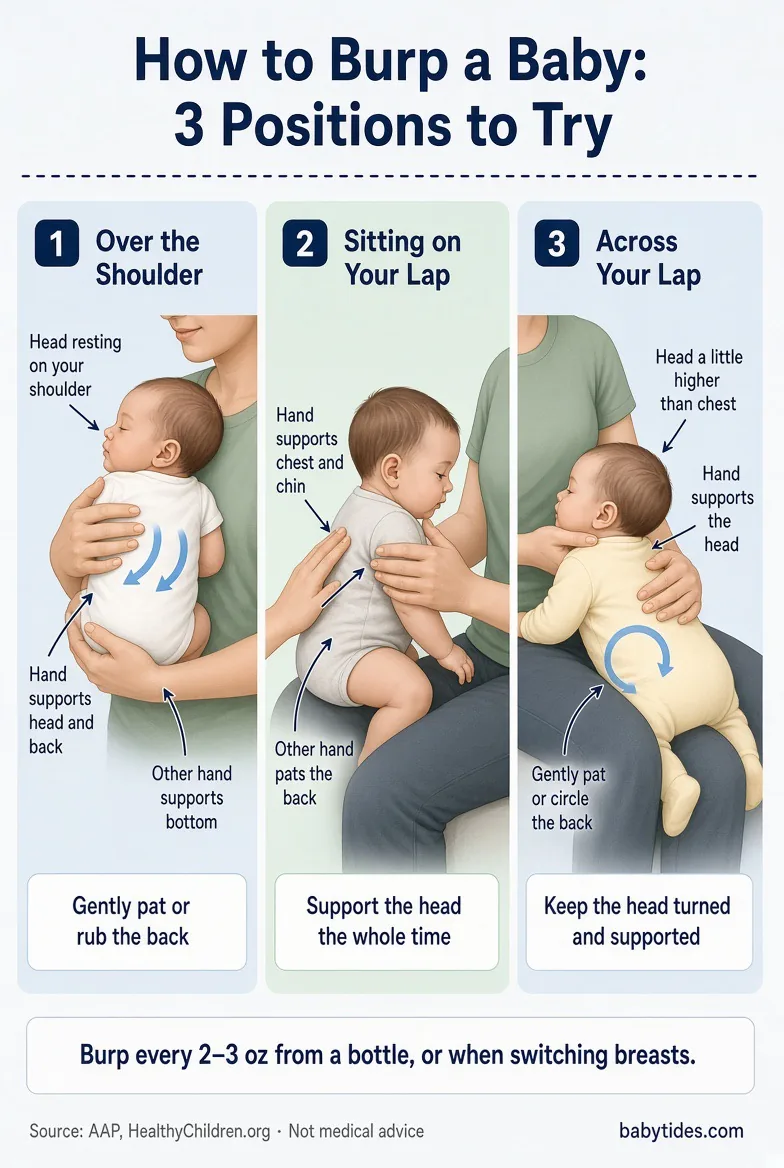
How to burp your baby
The AAP describes three positions you can try [8]:
- Over your shoulder. Hold your baby upright with their head on your shoulder, supporting the head and back [8].
- Sitting on your lap. Sit your baby on your lap, support the chest and head with one hand, and pat the back with the other [8].
- Across your lap. Lay your baby tummy-down across your lap, support the head so it's higher than the chest, and gently pat or rub the back [8].
The AAP suggests burping a bottle-fed baby after every 2 to 3 ounces (60 to 90 ml), and a breastfed baby when switching breasts [8]. It notes that some breastfed babies swallow little air and may not need burping much at all [8]. If your baby hasn't burped after several minutes, it says to carry on feeding and not to worry, because no baby burps every time [8]. After the feed, burp again and keep your baby upright for 10 to 15 minutes to help with spit-up [8].
Spit-up, reflux and GERD
According to the AAP, spit-up, also called reflux or GER (gastroesophageal reflux), is when stomach contents move back up into the esophagus and sometimes out of the mouth or nose [1]. It describes babies who spit up without seeming cranky or in pain as "happy spitters" [1]. In the UK the same terms are spelled gastro-oesophageal reflux (GOR) and GORD [5].
The 2018 joint guideline from NASPGHAN and ESPGHAN, the North American and European societies for pediatric gastroenterology, hepatology and nutrition, defines GERD as reflux that causes troublesome symptoms affecting daily life, or complications [7]. It says that babies who are thriving, with no warning signs and no effect on feeding, growth or development, don't need tests or treatments, including medicines that lower stomach acid [7].
The AAP explains that the ring of muscle between the esophagus and the stomach may be immature or open at the wrong time, and that babies may spit up when the stomach is full or after a change in position, especially after a feed [1]. The NHS says this muscle gets stronger as a baby grows, and reflux should then stop [4].
The AAP separates spit-up from vomiting. It describes spit-up as an easy flow of a small amount of milk, often with a burp, that doesn't seem to bother the baby; vomiting is forceful, usually uses the belly muscles, is often uncomfortable and can leave the baby crying [2].
How common it is and when it eases
NICE says effortless regurgitation in well babies is very common, affecting at least 40%, usually starts before 8 weeks of age, and resolves before age 1 in about 90% of babies [5]. The NHS likewise says it usually starts before 8 weeks and gets better by about age 1 [4]. NASPGHAN and ESPGHAN say physiologic reflux seldom starts before 1 week or after 6 months of age [7].
The NHS lists these signs of reflux [4]:
- spitting up milk or vomiting during feeds or soon after
- coughing or hiccupping during feeds
- being unsettled during feeds
- swallowing or gulping after burping or feeding
- crying and not settling
- not gaining weight because food isn't staying down
The NHS says a baby can have these signs without being sick, which is sometimes called silent reflux [4]. It also says a doctor usually isn't needed if a baby is happy, healthy and gaining weight [4]. The AAP adds that improved head control, sitting up and starting solid foods also help reflux ease [1].
What the AAP and NHS suggest trying
The AAP suggests [1, 2]:
- burping your baby at natural pauses during a feed, upright with the head supported, and after the feed [1, 2]
- keeping your baby upright for about the first half-hour after a feed, with close supervision [1]; its spit-up article says at least 20 minutes [2]
- smaller, more frequent feeds, making sure your baby still takes in enough to stay hydrated and grow [1], and avoiding overfeeding [2]
- avoiding pressure on the belly and active play right after feeds, and putting off tummy time for a while after eating [2]
The NHS suggests [4]:
- asking a health visitor for advice and support
- getting advice on breastfeeding position or bottle-feeding technique
- holding your baby upright during feeds and for as long as possible afterward
- burping your baby regularly during feeds
NICE, which writes guidance for health professionals in England, recommends a step-by-step approach when a formula-fed baby has frequent regurgitation with marked distress: review the feeding history, reduce feed volumes only if they are too large for the baby's weight, try smaller and more frequent feeds, then try a thickened formula [5]. For a breastfed baby with frequent regurgitation and marked distress, it recommends a breastfeeding assessment by someone with the right training [5].
Thickeners, formula changes and medicines
Thickened feeds. The AAP says that for bottle-fed babies who spit up unusually often, a pediatrician may recommend thickening formula with a very small amount of baby cereal, and that solids should never be added to a bottle unless your pediatrician advises it [1]. Its spit-up article says the AAP now recommends oatmeal rather than rice cereal for babies with reflux who need thicker feeds, because of concerns about arsenic in rice [2]. The NHS says formula-fed babies may be given a powder to thicken their formula, or a pre-thickened formula [4]. NASPGHAN and ESPGHAN found that thickening reduces visible regurgitation, but its effect on other symptoms is less clear, and they rated the quality of the evidence low to very low [7].
Cow's milk allergy. The AAP says milk allergy can look like reflux or GERD, and a pediatrician may suggest a dairy-free diet for a breastfeeding parent or a special formula (extensively hydrolyzed or amino acid-based) for a formula-fed baby [1]. Its spit-up article says that if a baby has a true intolerance, their pediatrician may recommend a 1 to 2 week trial of hydrolyzed (hypoallergenic) formula [2]; the NASPGHAN and ESPGHAN algorithm suggests considering 2 to 4 weeks of such a formula, or removing cow's milk from the breastfeeding parent's diet, before acid-lowering medicine [7]. The NHS says a GP or specialist may check for cow's milk allergy, because its symptoms can be similar [4].
Alginates. NICE recommends considering a 1 to 2 week trial of an alginate medicine if distress continues in a breastfed baby after a breastfeeding assessment, and offering one to a formula-fed baby if the stepped approach hasn't worked, stopping the thickened formula [5].
Acid-lowering medicines. NICE says not to offer proton pump inhibitors (PPIs) or H2 blockers for visible regurgitation on its own, and to consider a 4-week trial only for babies who also have unexplained feeding difficulties, distressed behavior or faltering growth [5]. NASPGHAN and ESPGHAN suggest that a PPI trial shouldn't be used to diagnose GERD in babies [7]. The AAP says feeding and position changes are the first-line treatment for both reflux and GERD, and that severe GERD may be treated with medicine or surgery [1]. The NHS calls surgery very rare [4]. This article doesn't name medicines or list doses.
Sleep: on the back, even with reflux
The AAP says back sleeping is still recommended for babies with reflux until they can roll over fully on their own, and calls the belief that these babies are more likely to choke on their backs a myth: the gag reflex naturally protects babies from choking [3]. It says raising the head of the crib doesn't reduce reflux and isn't safe, because a baby may roll toward the foot of the crib or into a position that causes serious breathing problems; it notes that NASPGHAN and ESPGHAN support this [3].
The AAP says wedges and positioners aren't needed for reflux and that it doesn't recommend sleep positioners or nests, and it says car seats, swings and reclined bouncy seats aren't safe places for sleep [3]. The NHS says to put a baby with reflux to sleep flat on their back, not on their side or front, and not to raise the head of the crib or bassinet [4]. NICE says positioning shouldn't be used to treat reflux in sleeping babies [5].
When to call the doctor
The AAP says to contact your pediatrician if your baby [1]:
- refuses to feed [1]
- cries or arches their back during feeds, as if in pain [1]
- has blood or a green color in the spit-up [1]
- spits up more often or more intensely, such as forceful vomiting [1]
- has a swollen, distended or hard belly [1]
- has breathing symptoms, such as wheezing or coughing [1]
The AAP also says to let your pediatrician know if your baby doesn't seem to be gaining weight or has fewer wet and dirty diapers [1]. It says to call right away if spit-up turns into forceful vomiting after every feed, or if there is any blood in the spit-up or vomit [2].
In the UK, the NHS says to see a GP if your baby [4]:
- isn't getting better after trying the feeding tips [4]
- has reflux for the first time after 6 months old [4]
- is over 1 year and still has reflux [4]
- isn't gaining weight or is losing weight [4]
The NHS says to get an urgent GP appointment or call 111 if your baby [4]:
- vomits green or yellow fluid, or there's blood in the vomit [4]
- has projectile vomiting, more forceful than usual [4]
- has blood in their poop [4]
- has a swollen or tender tummy [4]
- has a very high temperature, or feels hot or shivery [4]
- keeps being sick and can't keep fluids down [4]
- has diarrhea for more than a week, or signs of dehydration [4]
- won't stop crying and is very distressed [4]
- refuses to feed [4]
NICE says frequent, forceful vomiting in a baby younger than 2 months may be a sign of pyloric stenosis, and that green or yellow-green vomit may be a sign of a bowel blockage; both need urgent assessment [5]. In the US, the emergency number is 911. Elsewhere, call your local emergency number.
For a high temperature, see fever in babies. For crying and arching that isn't explained by feeds, see our guide to baby crying and colic.
Keeping a record
Among the signs to watch, the AAP mentions weight gain and the number of wet and dirty diapers [1], the NHS mentions weight gain [4], and NICE asks health professionals to review the feeding history [5]. For typical feed amounts, see how much babies eat.
BabyTides is being built to help with the record. You'll be able to log feeds and diapers in a tap and track weight on WHO growth charts. It can't tell you whether your baby has reflux or GERD.
Keep reading
 Health · 0–24 monthsRSV and bronchiolitis in babies: what health organizations saySymptoms, how long it lasts, care at home, US and UK protection options, and when to call, from the AAP, CDC, NHS and NICE.
 Health · 0–24 monthsHow can I help a baby with a cold or stuffy nose?Saline drops, suction, fluids, cough and cold medicine age limits in the US and UK, and when to call, from the AAP, FDA and NHS.
 Health · 0–24 monthsFever in babies: when to call the doctorWhich temperature counts, how to measure it, medicine age limits in the US and UK, and when to call, from the AAP, NHS and NICE.
BabyTides is coming to iPhone and Android. Join the waitlist and we'll email you when it opens.
Join the waitlistSources
- American Academy of Pediatrics, HealthyChildren.org. Gastroesophageal Reflux (GER) & Gastroesophageal Reflux Disease (GERD). Updated December 29, 2024.
- American Academy of Pediatrics, HealthyChildren.org. Why Babies Spit Up. Updated January 3, 2025.
- American Academy of Pediatrics, HealthyChildren.org. What is the safest sleep solution for my baby with reflux? Updated November 30, 2021.
- NHS 111 Wales (adapted from NHS.uk). Reflux in babies. Last updated November 14, 2025.
- National Institute for Health and Care Excellence (NICE). Gastro-oesophageal reflux disease in children and young people: diagnosis and management (NG1). Published January 14, 2015; updated October 9, 2019.
- National Institute for Health and Care Excellence (NICE). Reflux in babies (information for the public, NG1).
- Rosen R, Vandenplas Y, Singendonk M, et al. Pediatric gastroesophageal reflux clinical practice guidelines: joint recommendations of NASPGHAN and ESPGHAN. Journal of Pediatric Gastroenterology and Nutrition. 2018;66(3):516–554.
- American Academy of Pediatrics, HealthyChildren.org. Baby Burping, Hiccups and Spit Up.
Sources checked October 27, 2026. Source 8 checked November 1, 2026.