 BabyTides™
Join the waitlist
Development · 0–24 months
How to play with your baby: simple ideas by age, 0 to 24 months
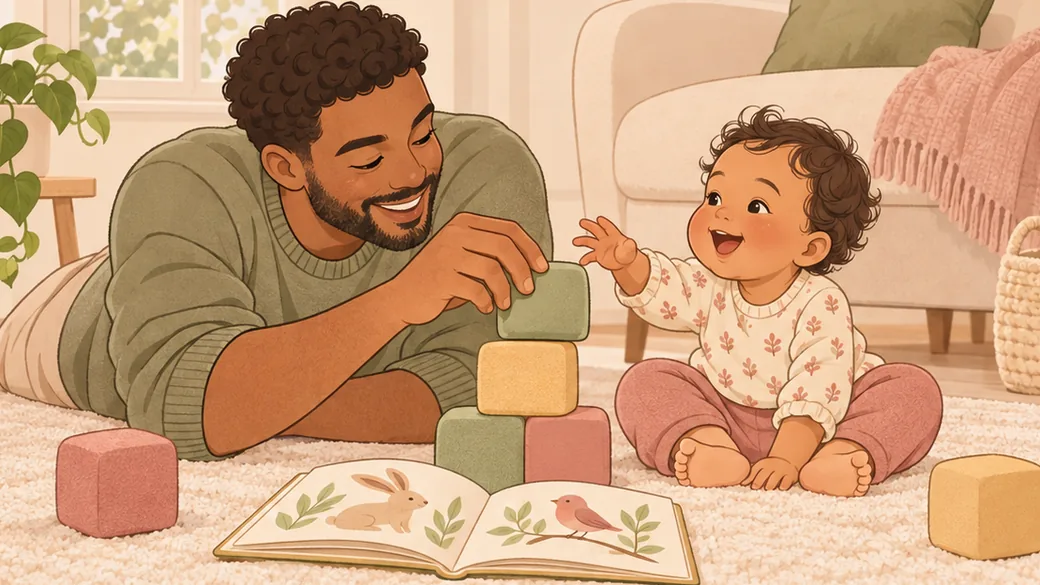
Play with a baby rarely looks like a game. It's a smile returned, a song during a diaper change, a toy dropped for the tenth time. Here's what the AAP, the CDC and the NHS suggest at each age, in the first two years, with no special toys needed.
Quick answers
How do you play with a newborn?
Mostly by talking, singing and responding. The CDC suggests answering your baby's sounds with smiles and talk, holding and cuddling them often, and looking at bright pictures or faces together [3]. Supervised tummy time counts too [1, 3].
Do babies need special toys?
No. The AAP says what matters most is your attention, not fancy electronic gadgets, and points to simple things like blocks, containers and shape sorters for toddlers [1]. The NHS suggests using household items you already have [2].
Is it OK for my baby to watch TV?
The CDC doesn't recommend screen time before age 2, except video calls with loved ones [3, 6]. The AAP recommends keeping media to a minimum, or none, other than video chatting, for children under 18 months [10].
BabyTides app · coming to iPhone and Android
Note the firsts as they happen
Mark milestones when you see them and add a note in your own words. Look back at them any time.

- Milestones
- Notes
- Weekly summary
Want paper for now? Print our free newborn log, no sign-up needed.
Not in the App Store or Google Play yet. We’ll email you when it opens.
Why play matters so early
The American Academy of Pediatrics calls play serious business for a child's health and development [1]. It says play builds skills like planning, getting along with others and managing emotions, and can help children cope with stress [1]. The AAP notes that pediatricians may even write a "prescription for play" at checkups through age 2 [1].
For a baby, the most important playmate is you. The AAP describes a baby's first smile as the start of playful learning [1]. Copying their coos to make a back-and-forth "conversation" is, in the AAP's words, the basis of social language skills [1].
Books belong here as well. The AAP encourages shared reading from birth, saying it builds a loving bond during a key time of brain development and lays groundwork for language and later learning [11]. The NHS notes that even 10 minutes of reading a day helps, and that small babies enjoy looking at picture books [2].
Birth to 3 months
In the first weeks, play and care are the same thing. The CDC suggests:
- Respond warmly when your baby makes sounds, so they learn to take turns "talking" [3]. Copy their sounds back [3].
- Talk, read and sing to your baby, including during feeds, dressing and baths [3].
- Hold and cuddle them often. The CDC says you can't spoil a baby by comforting them [3].
- Look at bright pictures or faces together, and place a baby-safe mirror where they can see it [3].
- Shake a rattle to one side of their head and see if they look for the sound [3].
- Give tummy time while your baby is awake, with toys at eye level, and stay with them [3].
The CDC also suggests watching your baby's cues to tell whether they want to interact or need a break [3]. More on getting started on the tummy is in our guide to tummy time.
4 to 6 months
Play gets more hands-on in these months. Ideas from the CDC and the NHS:
- Put toys within reach on a blanket or play mat, so your baby can reach, kick and explore [2, 4]. A little later, place them just out of reach to encourage rolling [5].
- Let your baby mouth safe toys. The CDC says to choose things that aren't sharp, hot or small enough to choke on [4].
- Offer easy-to-grip toys like rattles or cloth books [4].
- Move a bright toy slowly side to side while your baby lies on their back, and see if their eyes follow it [4].
- Play peek-a-boo and watch for smiles [4].
- Name the things you see on walks, like cars, trees and animals, and point to what your baby is looking at [5].
- Sing and play music, and try different sounds and voices to see which your baby likes [5].
The CDC suggests some time on the floor or a play mat every day [4, 5], and not keeping your baby in swings, strollers or bouncy seats for too long [4]. The AAP also suggests changing your baby's position so they see the world from new angles [1].
7 to 12 months
Now your baby is a busy explorer. The AAP describes babies as "little scientists" who learn by handling and testing things [1]. Games that work well at this age:
- Peek-a-boo and hide-and-find. Cover your head with a cloth for your baby to pull off, or hide a toy under a blanket [6]. The AAP says peek-a-boo reinforces the idea that things still exist when out of sight [1].
- Drop it, again. Letting your baby drop toys shows cause and effect [1]. The CDC suggests turning it into a game by handing them back [6].
- In and out. Dump blocks from a container and put them back together [6].
- My turn, your turn. Pass a toy back and forth [6].
- Mirror play. Use a mirror to show facial expressions [1].
- Noise. Pots, pans or small instruments let your baby make sounds [7].
- Books. Name the pictures as you point to them, and try books with textures or flaps [6, 7].
- Gestures. Teach waving bye-bye and shaking your head for no [6].
The AAP suggests a safe space to crawl and explore, a few toys within reach, and new textures like grass or bubbles [1]. The CDC suggests placing toys just out of reach to encourage crawling or scooting, and putting your baby near things they can safely pull up on [6]. Our article on rolling, sitting and crawling covers when most babies reach those skills.
12 to 18 months
First steps and first words shape play in this stretch. The CDC suggests:
- Let your toddler push things around, like empty boxes, to practice walking [7]. The CDC says baby walkers are not recommended [7].
- Play with blocks and other toys that use the hands [7].
- Point out interesting things, like trucks or animals, and name what your child points at [7].
- Narrate what you're doing, and sing about it [7].
- Roll a ball, push a toy car, or put blocks in and out of a container together [8].
- Blow bubbles for your child to pop while you say "pop, pop" [8].
For more on how talking grows in the second year, see first words.
18 to 24 months
This is a good age to encourage pretend play. The CDC suggests giving your child a spoon to "feed" a stuffed animal, taking turns pretending, and offering toys like a doll with a baby blanket [8]. Push and pull toys are a good fit too [8].
Other ideas for this age:
- Drawing with crayons or painting, after showing how to hold the crayon [2, 9].
- Sock puppets, and walks together [2].
- Dress-up with old hats and scarves, from about 2 years [2, 9].
- Simple shape, color or animal puzzles, naming each piece as it goes in [9].
- Kicking, rolling and throwing balls, and building block towers to knock down in turns [9].
- Sand toys, plastic containers, spoons or a funnel in the bath or a sandbox [9].
The CDC notes that 2-year-olds tend to play side by side rather than together, and suggests staying close during playdates [9].
Toys and screens
Toys don't need to be new or clever. The AAP favors simple, inexpensive objects like blocks, containers and shape sorters over electronic gadgets [1]. The NHS suggests water play with unbreakable things like bottles, sponges and spoons [2].
On screens, the main U.S. sources agree on the direction but use different ages:
- The CDC doesn't recommend screens for children under 2, except video calls with family and friends [3, 6, 7]. From 2 years, its milestone page suggests no more than one hour a day of children's programming, watched with an adult [9].
- The AAP recommends keeping media to a minimum, or none, other than video chatting, for children under 18 months [10]. It says babies under 18 months learn best from real-world interaction [12].
- The NHS, in its play ideas from about 2 years, suggests limiting screen time each day and watching with your child [2].
The CDC also suggests keeping your own screen use low during time together, so you can respond to your baby [3, 8].
Playing safely
- Stay with your baby during tummy time, and if they get sleepy, move them onto their back in a safe sleep space [3].
- Never leave a young child alone in the bath or near water. The NHS says a child can drown in less than 2 inches (5 cm) of water [2].
- Check toys for sharp edges and small parts, and follow the age labels [2].
- Keep button batteries away from children. The NHS says to go to the emergency department or call for an ambulance right away if you think one has been swallowed (in the U.S., call 911) [2].
- Take off loose cords, strings or ribbons from dress-up clothes [2].
- Once your baby is on the move, baby-proof your home and lock away medicines and cleaners. In the U.S., the Poison Help Line is 800-222-1222 [6].
Keeping track
BabyTides is being built with play ideas by age: short games that fit what your baby is practicing that month, with no special toys needed. It won't grade your baby or tell you whether they are ahead or behind. If you have a question about their development, your pediatrician is the right person to ask.
Keep reading
 Development · 0–6 monthsTummy time: when to start and how to make it easierHow much tummy time babies need, why it helps, and what to try if your baby protests.
 Development · 12–24 monthsFirst words: how talking develops from 12 to 24 monthsWhat the CDC lists for 1 year to 2 years, everyday ways to help, and when to talk with your pediatrician.
 Development · 2–12 monthsRolling, sitting and crawling: when babies usually do itWhen babies roll, sit and crawl, why the CDC, AAP and WHO give different ages, and when to talk to your pediatrician.
BabyTides is coming to iPhone and Android. Join the waitlist and we'll email you when it opens.
Join the waitlistSources
- Yogman M; American Academy of Pediatrics, HealthyChildren.org. The Power of Play: How Fun and Games Help Children Thrive. Updated May 3, 2023.
- NHS. Baby and toddler play ideas. Reviewed August 27, 2024.
- Centers for Disease Control and Prevention. Milestones by 2 Months. Reviewed May 16, 2026.
- Centers for Disease Control and Prevention. Milestones by 4 Months. Reviewed May 16, 2026.
- Centers for Disease Control and Prevention. Milestones by 6 Months. Reviewed May 16, 2026.
- Centers for Disease Control and Prevention. Milestones by 9 Months. Reviewed May 16, 2026.
- Centers for Disease Control and Prevention. Milestones by 1 Year. Reviewed May 16, 2026.
- Centers for Disease Control and Prevention. Milestones by 18 Months. Reviewed May 16, 2026.
- Centers for Disease Control and Prevention. Milestones by 2 Years. Reviewed May 16, 2026.
- American Academy of Pediatrics, HealthyChildren.org. Where We Stand: Screen Time. Updated December 13, 2023.
- American Academy of Pediatrics, HealthyChildren.org. Beyond Literacy: Shared Reading Starting at Birth Offers Lifelong Benefits. September 29, 2024. On the AAP policy statement "Literacy Promotion: An Essential Component of Primary Care Pediatric Practice," Pediatrics, 2024.
- Munzer T; American Academy of Pediatrics, HealthyChildren.org. Helping Kids Thrive in a Digital World: AAP Policy Explained. Updated June 3, 2026.
Sources checked November 12, 2026.