 BabyTides™
Join the waitlist
Development · 12–24 months
First words: how talking develops from 12 to 24 months
Between the first and second birthdays, many children go from a word or two to short phrases. Here's what the CDC lists for 1 year, 15 months, 18 months and 2 years, what health organizations suggest to help, and when to talk with your pediatrician.
Every child has their own pace
The NHS puts it simply: children learn to talk at different ages [7]. The AAP notes that some children with normal hearing and intelligence don't say much during their second year, and that boys often develop language more slowly than girls [5].
The milestones below come from the CDC's checklists. The CDC describes milestones as things most children, 75% or more, can do by a certain age [3]. So a milestone shows what most children can do by that age. It is not the earliest age at which children start.
BabyTides app · coming to iPhone and Android
Note the firsts as they happen
Mark milestones when you see them and add a note in your own words. Look back at them any time.

- Milestones
- Notes
- Weekly summary
Want paper for now? Print our free newborn log, no sign-up needed.
Not in the App Store or Google Play yet. We’ll email you when it opens.
Around the first birthday
By 1 year, the CDC lists these language and communication milestones [1]:
- waves "bye-bye"
- calls a parent "mama" or "dada" or another special name
- understands "no," pausing briefly or stopping when you say it
By 15 and 18 months
By 15 months, the CDC lists that most children [2]:
- try to say one or two words besides "mama" or "dada," like "ba" for ball or "da" for dog
- look at a familiar object when you name it
- follow directions given with both a gesture and words
- point to ask for something or to get help
By 18 months, the list adds [3]:
- tries to say three or more words besides "mama" or "dada"
- follows one-step directions without any gestures, like handing you a toy when you say "Give it to me"
Notice that early words are often incomplete. The CDC's own example is "ba" for ball [2], and it reminds parents that a child's early words are not complete [2].
By 2 years
By their second birthday, the CDC lists that most children [4]:
- point to things in a book when you ask, like "Where is the bear?"
- say at least two words together, like "More milk"
- point to at least two body parts when you ask
- use more gestures than waving and pointing, like blowing a kiss or nodding yes
The AAP describes the end of the second year in a similar way: most toddlers can put two words together to make a short sentence, though children vary [5]. It describes a typical two-year-old as having a rapidly growing vocabulary of 50 or more words [6]. By midway through the second year, the AAP says, many children use a few action words like "go" and "jump" [5].
Understanding comes first
Several of the CDC milestones are about understanding, not speaking: looking at an object when you name it, following a direction with a gesture at 15 months, and following a one-step direction without gestures at 18 months [2, 3]. Pointing counts too. At 15 months, the CDC lists pointing to ask for something or to get help [2]. So when you think about your child's talking, look at what they understand and how they communicate, not only at how many words they say.
Everyday ways to help
The CDC notes that children learn by talking, playing and interacting with others [3]. The suggestions below come from the CDC, the AAP and the NHS:
- Get face to face. Talk with your child facing them, at their eye level when you can [3].
- Name what they point at, then wait. When your child points to something, name it and wait a few seconds to see if they make a sound before handing it over. If they do, acknowledge it and repeat the name [2].
- Repeat and add. Repeat what your child says and add to it, to teach them more words [2, 3].
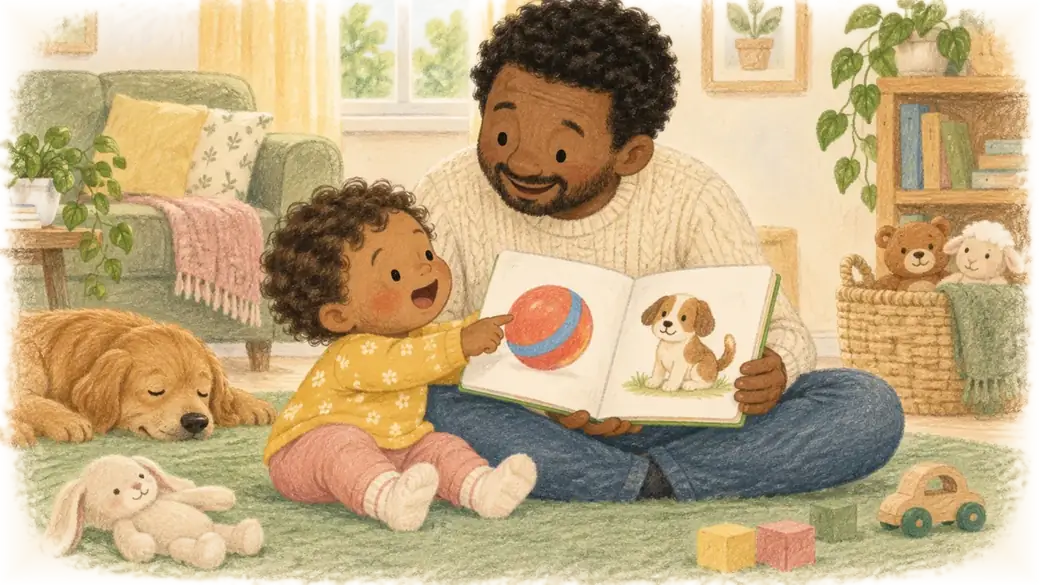
- Read and look at pictures together. Read books and talk about the pictures using simple words [3]. The NHS suggests looking at picture books together and giving your child time to point things out [7].
- Sing. Songs like "Head, Shoulders, Knees, and Toes" help teach the names of body parts. After a few times, the CDC suggests pausing to see if your child sings some of the words [4].
- Use simple words and real names. The AAP suggests speaking slowly and clearly, in simple words and short sentences, and teaching the correct names of objects and body parts [5].
- Don't correct by criticizing. The AAP advises never making fun of language mistakes. Instead, let your child finish, then say the correct word back to them [5].
- Talk in your home language. The NHS says it's important to chat with your child in the language or languages you speak at home [7].
The AAP also suggests not comparing your child's talking with other children's, because children vary so much [6].
What about screens?
For children under 2, the CDC and the NHS give similar advice. On its 18-month milestone page, the CDC says screen time is not recommended for children younger than 2 and suggests limiting it to video calls with loved ones [3]. The NHS advises avoiding screen time for babies and toddlers, and if you do use screens, using them for shared activities that encourage bonding and interaction [7]. From age 2, the CDC suggests no more than 1 hour a day of a children's program with an adult present [4]. The CDC also suggests limiting your own screen time when you're with your child, so you can respond to their words and actions [3].
When to talk to your pediatrician
If your child isn't meeting one or more milestones, has lost skills they once had, or you have other concerns, the CDC's advice is not to wait and to act early [2]. It suggests talking with your child's doctor, sharing your concerns and asking about developmental screening. If you or the doctor are still concerned, you can ask for a referral to a specialist [2]. In the US, the CDC also suggests contacting your state or territory's early intervention program to see whether your child can get services [2].
In the UK, the NHS suggests speaking to your health visitor or nursery key worker if you're worried. Your health visitor may put you in touch with a speech and language therapy team or give you details of local activities. You can also contact your local speech and language therapy service for advice [7].
Hearing matters for language. The AAP says that if your pediatrician suspects your child has difficulty with language, they will do a physical exam and a hearing test, and may refer you to a specialist. It adds that finding a language delay or hearing problem early is critically important [6].
Writing it down helps
It's easy to lose track of when your child first said a new word or started following a simple request. A few notes over the months give you something concrete to bring to checkups. BabyTides will show the CDC milestones for your child's age, with skills you can mark as noticed. It won't tell you whether your child is ahead or behind, because every child develops at their own pace.
Not sure of your child's exact age, or was your child born early? Try our baby age calculator. For the early months, see our guide to tummy time, and for nights, why babies wake up at night.
Keep reading
 Development · 8–18 monthsFirst steps and walking: when babies usually startWhen babies take first steps, how wide the normal range is, why walkers are a bad idea, and when to talk to your pediatrician.
 Development · 0–24 monthsHow to play with your baby: simple ideas by age, 0 to 24 monthsGames for each age from the AAP, CDC and NHS, plus what they say about toys, screens and safety.
 Development · 0–24 monthsAdjusted age for babies born earlyLearn how to calculate adjusted age after a preterm birth, read a milestone checklist, and describe your baby’s progress to your pediatrician.
BabyTides is coming to iPhone and Android. Join the waitlist and we'll email you when it opens.
Join the waitlistSources
- Centers for Disease Control and Prevention. Milestones by 1 Year. Reviewed May 16, 2026.
- Centers for Disease Control and Prevention. Milestones by 15 Months. Reviewed May 16, 2026.
- Centers for Disease Control and Prevention. Milestones by 18 Months. Reviewed May 16, 2026.
- Centers for Disease Control and Prevention. Milestones by 2 Years. Reviewed May 16, 2026.
- American Academy of Pediatrics, HealthyChildren.org. Language Development: 1 Year Olds. Updated August 1, 2009.
- American Academy of Pediatrics, HealthyChildren.org. Language Development: 2 Year Olds. Updated August 1, 2009.
- NHS Best Start in Life. First words: 1 to 2 years. Last modified September 4, 2026.
Sources checked October 26, 2026.