 BabyTides™
Join the waitlist
Pregnancy · Weeks 36–42
Signs of labor and when to go to the hospital
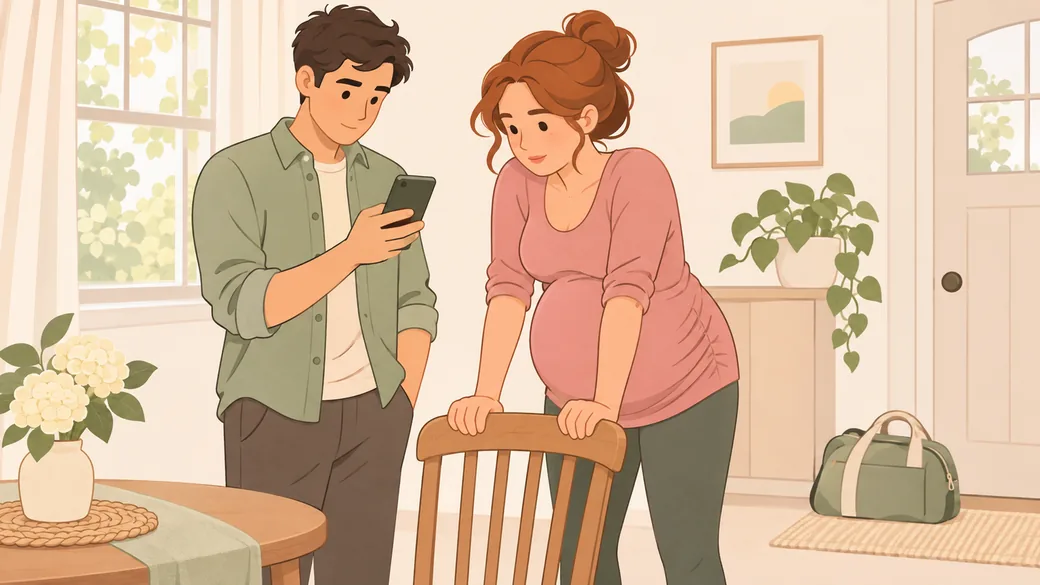
Late in pregnancy, almost every twinge raises the same question: is this it? Here is how health organizations describe the signs of labor, how they tell real contractions from practice ones, and when they say to call your doctor or midwife, from ACOG, MedlinePlus, Mayo Clinic and the NHS. This article summarizes guidance from health organizations; it isn't personal medical advice.
Quick answers
How do I know labor has started?
The NHS lists contractions or tightenings, a "show" (mucus from the cervix), backache or a heavy, aching feeling, an urge to go to the toilet, and your waters breaking as possible signs [4]. ACOG says true labor contractions come at regular intervals, keep coming when you rest or move, and steadily get stronger [1].
When should I call?
ACOG says to call your ob-gyn or other obstetric care provider if you think you're in labor or aren't sure [1]. The NHS says the same: call your midwife or maternity unit if you think you're in labor, and you can call if you're unsure or worried about anything [4].
Should I go in as soon as contractions start?
Not always. The NHS says early labor can take hours or sometimes days, that you'll probably be advised to stay at home at first, and that if you go in, you may be sent home again [4]. Some signs mean you should call straight away, whatever the timing; they're listed further down.
BabyTides app · coming to iPhone and Android
Get ready for the first weeks with your baby
BabyTides is a simple log for life with a newborn: feeds, sleep and diapers in a tap, and a weekly summary to look back on.

- Feeds
- Sleep
- Diapers
Want paper for now? Print our free newborn log, no sign-up needed.
Not in the App Store or Google Play yet. We’ll email you when it opens.
Signs that labor may be getting close
Some changes can come days or even weeks before labor, so on their own they don't mean you need to go in.
- The baby "dropping." MedlinePlus says the baby's head settles into the pelvis, breathing may get easier and you may need to pee more often. First-time mothers often notice this a few weeks before birth [2].
- More discharge or a show. Mayo Clinic says the mucus plug can cause more vaginal discharge that is clear, pink or slightly bloody, several days before labor or at its start [3]. MedlinePlus says bloody or brownish discharge may mean your cervix has begun to open, but active labor may still be days away [2].
- Looser stools. MedlinePlus lists frequent bowel movements with looser stools as a possible sign [2].
- Backache or a heavy, aching feeling, which the NHS includes among the signs that labor has begun [4].
Real labor or Braxton Hicks?
Braxton Hicks are "practice" contractions. ACOG says they can happen for many weeks before real labor, and that false contractions are usually less regular and not as strong [1]. Here is how the sources describe the difference.
| Braxton Hicks | Labor contractions | |
|---|---|---|
| Pattern | No regular pattern [1, 3] | Regular, and closer together over time [1, 3] |
| Rest and moving | May stop when you walk, rest or change position [1, 3] | Keep coming whatever you do [1, 2] |
| Strength | Usually weak, or ease off [3] | Steadily stronger; hard to talk through [1, 3] |
| Where you feel it | Usually only at the front [1] | Often starts in the back and moves to the front [1] |
| Length | Typically short [2] | MedlinePlus: 30 to 70 seconds, getting longer [2]. Mayo Clinic: about 60 to 90 seconds [3]. |
ACOG suggests timing the contractions and noticing whether they continue while you rest and drink water: if rest and fluids make them go away, they are not true labor contractions [1]. Sometimes the only way to tell is an exam to check for changes in your cervix [7].
How to time contractions
Mayo Clinic says to time contractions from the beginning of one to the beginning of the next, and to look for a pattern that gets closer together over time [3]. Write down when each one starts and how long it lasts. A notes app or a piece of paper is enough, and it gives your doctor or midwife the details they'll ask for when you call.
If your water breaks
Your waters can break before labor starts or during it [4]. The fluid can come as a trickle or a gush [2, 3], and the NHS says it can be hard to tell apart from urine. It's normally clear and pale, and may be slightly bloodstained at first [4].
- ACOG says to call your ob-gyn's office and follow their instructions [1]. MedlinePlus says to tell your provider even if contractions haven't started [2].
- The NHS says to use a pad, not a tampon, so your midwife can check the color, and to tell your midwife immediately if the fluid is smelly or colored, or if you're losing blood [4].
- Contractions usually follow within 24 hours [2, 4]. If they don't, the NHS says you'll be offered an induction because of a small increased risk of infection for the baby [4].
Early labor at home
The start of labor is called the latent phase. The NHS describes it as the time when the cervix softens, thins and begins to open, and says it can take hours or sometimes days [4]. Mayo Clinic says that once the cervix is open 6 centimeters or more, labor usually moves faster [3].
The NHS says to call your midwife if you're unsure or worried at any point in early labor [4].
When to call about contractions
Health services give slightly different contraction thresholds. Your own hospital or birth center may give you a different plan, and that plan is the one to follow.
| Source | Call when contractions are |
|---|---|
| MedlinePlus (US) | Regular and painful, every 5 to 10 minutes for 60 minutes, or lasting 60 to 90 seconds [2] |
| NHS (UK) | Regular, coming every 5 minutes or more often [4] |
| ACOG (US) | Any time you think you're in labor, or aren't sure [1] |
Call right away
Call your doctor, midwife or maternity unit straight away, even in the middle of the night, if [2, 3, 4, 5]:
- your water breaks, even without contractions [1, 2, 4]
- the fluid is smelly or colored [4]
- you have vaginal bleeding: the NHS says any bleeding [4], and MedlinePlus says any bleeding other than light spotting [2]
- your baby is moving less than usual, or you can't feel movements; the NHS says not to wait until the next day [4, 5]
- you're under 37 weeks and think you might be in labor [3, 4]
- any contraction lasts longer than 2 minutes, or you have 6 or more contractions in 10 minutes [4]
If you think the baby is coming now and you have a strong urge to push, the NHS says to call 999 [4]. In the US, call 911.
The CDC also lists urgent warning signs during pregnancy, such as a severe headache that won't go away, changes in vision, trouble breathing, chest pain, or a fever of 100.4°F (38°C) or higher, and says to get medical care immediately for any of them [6].
Before labor starts
At a late prenatal visit, it can help to ask your doctor or midwife a few practical questions, so you aren't working them out in the middle of the night:
- Which number should I call, day and night?
- When do you want me to call about contractions, and when should I come in?
- What should I do if my water breaks before contractions start?
- Where do I go when I arrive: the main entrance, labor and delivery, or a maternity triage unit?
For what to pack, see our hospital bag checklist.
Not sure how far along you are? Our weeks to months chart and due date calculator can help, and the week-by-week pages cover what's common in the last weeks.
Getting ready for your baby
Your baby's first weeks, a little calmer
BabyTides is a simple log and guide for life with a newborn: feeds, sleep and diapers in a tap, and what's common at each age, from the AAP, CDC and NHS. It's coming to iPhone and Android. Join now and we'll email you when it opens.
Join the waitlistNot in the App Store or Google Play yet. Your due date is optional.
Sources
- American College of Obstetricians and Gynecologists. How to Tell When Labor Begins. Patient FAQ.
- MedlinePlus Medical Encyclopedia, U.S. National Library of Medicine. Am I in labor? Reviewed May 29, 2026.
- Mayo Clinic Staff. Signs of labor: Know what to expect. Mayo Clinic.
- NHS. Signs that labour has begun. Reviewed November 9, 2023.
- NHS. Your baby's movements.
- Centers for Disease Control and Prevention. Urgent maternal warning signs. Hear Her campaign.
- American College of Obstetricians and Gynecologists. Is it normal to feel fake contractions? Ask ACOG.
Sources checked November 10, 2026.