 BabyTides™
Join the waitlist
Feeding · 0–24 months
Water, juice and cow's milk: when can my baby have them?
For the first months, breast milk or formula is all a baby drinks. After that, water, cow's milk and other drinks come in step by step. Here's what the CDC, the AAP, the NHS and the European pediatric nutrition society ESPGHAN say about each one from birth to age 2, and where their advice differs.
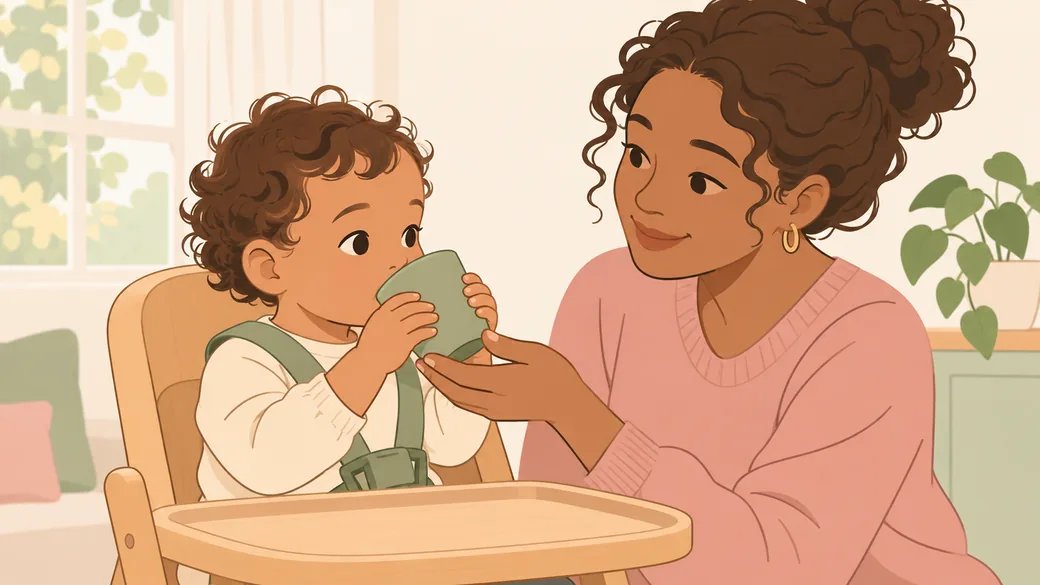
Quick answers
When can babies drink water?
From around 6 months. The AAP and CDC suggest starting with a small amount, about 4 to 8 ounces (120 to 240 ml) a day between 6 and 12 months [3, 4]. The NHS suggests sips of water from a cup with meals from around 6 months [6].
When can my baby have cow's milk?
As a drink, at 12 months. The CDC says whole cow's milk can start at 12 months but not before [2], and the NHS and ESPGHAN also say it shouldn't be the main drink before 12 months [6, 7]. The NHS adds that from around 6 months, cow's milk is fine in cooking or stirred into food [6].
Can babies have juice?
The CDC says no fruit or vegetable juice before 12 months [1], and the AAP says no fruit juice before age 1 [4, 5]. The NHS says babies under 12 months don't need juice, and if you do give it, to dilute it and keep it to mealtimes [6].
BabyTides app · coming to iPhone and Android
Keep track of feeds without the mental math
Log nursing, bottles and diapers in a tap. See when the last feed was and how the day added up.

- Feeds
- Diapers
- Weekly summary
Want paper for now? Print our free newborn log, no sign-up needed.
Not in the App Store or Google Play yet. We’ll email you when it opens.
The first 6 months
The AAP recommends breastfeeding as a baby's only source of nutrition for about the first 6 months [4]. The NHS puts it the same way: breast milk is the only food or drink babies need in their first 6 months, and fully breastfed babies don't need water before they start solid foods [6]. The NHS says formula-fed babies under 6 months may need a little cooled boiled water, in small sips, when the weather is hot [6].
The AAP's drinks guide doesn't suggest offering water before about 6 months [4]. If you're not sure whether your young baby needs anything other than milk, your pediatrician is the person to ask.
Water from about 6 months
Around the time solids start, water can come in too. The AAP says that from around 6 months you can offer a little water, 4 to 8 ounces (120 to 240 ml, or half a cup to 1 cup) a day, and that at this age it's unlikely to replace much breast milk or formula [4]. The CDC lists the same amount for 6 to 12 months [3]. Breast milk or formula is still the main drink through the first year [3, 6].
The AAP's suggested amounts go up after the first birthday: 8 to 32 ounces (1 to 4 cups) of water a day for children 12 to 24 months [4]. The AAP also notes that where tap water has fluoride, drinking it helps prevent tooth decay later [4].
In the UK, the NHS says there's no need to boil drinking water for babies once they're over 6 months [6].
For first foods and signs your baby is ready for solids, see our guide to starting solids.
Cow's milk
The CDC says you can introduce whole cow's milk at 12 months, but not before [2]. It gives three reasons for waiting: cow's milk before 12 months may raise the risk of intestinal bleeding, it has too many proteins and minerals for a baby's kidneys, and it doesn't have the right amounts of the nutrients babies need [1, 2].
ESPGHAN, the European society for pediatric gastroenterology and nutrition, says whole cow's milk shouldn't be the main drink before 12 months [7]. The NHS agrees on the main drink and adds that from around 6 months, cow's milk is fine in cooking or stirred into food [6].
How much, and what kind, after 12 months
The AAP suggests about 16 ounces (2 cups) of cow's milk a day for children 12 to 24 months, and its chart advises whole milk at this age, moving to nonfat (skim) or low-fat (1%) milk from age 2 [4]. The CDC says children 12 through 23 months need about 2 servings of dairy a day, which can include milk, full-fat yogurt and cheese [2]. It notes that young children need fat for healthy growth, and that a child who drinks too much cow's milk may not be hungry for other foods with important nutrients [2]. If your child is gaining weight too quickly or your family has a history of obesity, high cholesterol or heart disease, the CDC suggests talking with your child's doctor about which milk to use [2].
The NHS says pasteurized whole milk or semi-skimmed milk can be a main drink from age 1, and that skimmed and 1% milk shouldn't be the main drink before age 5 [6].
Whatever milk you choose, the CDC says not to give your child raw or unpasteurized milk, from cows, goats or sheep, because it can carry harmful germs [2].
Milk alternatives and other milks
Milk alternatives aren't for the first year: the NHS lists them from age 1 [6], and the CDC says plant-based milk alternatives shouldn't be given before 12 months [2]. After that, their views on which alternatives work differ.
- AAP: other than soy milk, plant-based milks aren't recommended in place of dairy milk, because most aren't nutritionally equivalent to cow's milk. The AAP calls soy milk an acceptable alternative [4].
- CDC: unflavored, unsweetened plant-based drinks fortified with calcium and vitamin D, such as soy, oat, almond or rice, can help meet a child's dairy needs from 12 months. Nutrients vary between products, so the CDC suggests checking labels [2].
- NHS: unsweetened, calcium-fortified alternatives such as soy, oat or almond drinks can be given from age 1. Rice drinks shouldn't be given to children under 5 because of their arsenic levels [6].
The NHS says goat's and sheep's milk aren't suitable as a main drink under 1 year, and can be a main drink from age 1 if pasteurized [6].
If your child has a milk allergy or doesn't drink dairy, ask your pediatrician which option suits them.
Toddler milks
The AAP calls toddler milks, often sold as "next stage" or "transitional" drinks, unnecessary. It says for most children they offer no nutritional advantage over a well-balanced diet, cost more and contain added sugars [4]. The NHS says formula, including follow-on and growing-up milks, isn't needed once a baby is 12 months old [6].
Fruit juice
The CDC says children under 12 months shouldn't have any fruit or vegetable juice [1], and the AAP says the same about fruit juice [4, 5]. In its 2017 policy, the AAP said juice offers no nutritional benefit to children under 1 [5].
After the first birthday, the CDC calls juice unnecessary and repeats the AAP's limit of no more than 4 ounces (about 120 ml) of 100% fruit juice a day for children 1 through 3 [1, 5]. The AAP also says toddlers shouldn't be given juice from bottles or easy-to-carry sippy cups, or at bedtime, and that unpasteurized juice should be strongly discouraged at any age [5]. Eating whole fruit is always better than drinking juice, according to the AAP, because juice is very sweet and lacks the fiber found in fruit [4].
Fruit drinks, fruit-flavored drinks and juice drinks are a separate category: they contain added sugars, and the CDC says children shouldn't have them [1].
Drinks to skip
The CDC says children under 24 months shouldn't have added sugars [1]. Drinks with added sugar include soda, flavored milk, sports drinks, sweetened flavored water and juice drinks [1]. The AAP adds that caffeinated drinks are best avoided, and that because the health risks of sweeteners like stevia aren't well understood for children, it's best to avoid sweetened drinks even if they have no calories [4].
The NHS advises against squash, flavored milk, fizzy drinks and drinks labeled "fruit" or "juice" drinks for young babies, because the sugar in them can cause tooth decay, and says babies and young children shouldn't have tea or coffee [6].
Honey isn't a drink, but it often ends up in one. The CDC says not to give honey before 12 months, including in food, water, formula or on a pacifier, because it can cause botulism, a severe food poisoning [1].
Cups and bottles
The NHS suggests introducing a cup or beaker from around 6 months, and says an open cup or a free-flow cup without a valve helps babies learn to sip [6]. It says bottle feeding should be discouraged once a baby is 1 year old [6]. If your baby is still learning to take a bottle, our guide to bottle refusal covers what can help.
Where US and UK advice differ
| Question | US (AAP, CDC) | UK (NHS) |
|---|---|---|
| Juice before 12 months | None [1, 5] | Not needed; if given, diluted 1 part juice to 10 parts water, at mealtimes only [6] |
| Type of cow's milk from 12 months | Whole milk from 12 to 24 months (AAP) [4] | Whole or semi-skimmed from age 1 [6] |
| Plant-based milks from 12 months | AAP: only soy as an alternative [4]. CDC: fortified, unsweetened alternatives, including soy, oat, almond and rice [2] | Unsweetened, calcium-fortified alternatives; no rice drinks under 5 [6] |
| Water from 6 months | 4 to 8 ounces (120 to 240 ml) a day [3, 4] | Sips from a cup with meals; no amount given [6] |
The NHS page was last reviewed in October 2022 and was due for review in October 2025, so its advice may be updated [6]. All of these organizations agree that breast milk or formula is the main drink through the first year, and that cow's milk shouldn't be the main drink before 12 months [2, 6, 7].
Keeping track
As new drinks come in, it can help to know how much breast milk or formula your baby is still taking. BabyTides is being built to let you log nursing and bottles in a tap or two, with day and week reports you can show your pediatrician. It won't tell you what or how much your baby should drink; your pediatrician is the right person for that.
For how much babies eat in the first months, see how much should my baby eat.
Keep reading
 Feeding · 0–6 monthsHow much should my baby eat?How often and how much in the first months, breast or bottle, and the signs your baby is getting enough.
 Feeding · 0–4 monthsGrowth spurts and cluster feeding: what's normal?Why babies sometimes feed almost nonstop, what research shows about growth spurts, and signs your baby is getting enough.
 Feeding · 4–12 monthsStarting solids: when and howWhen to start, signs of readiness, first foods, peanut and egg, choking and foods to avoid, from the AAP, NHS, CDC and WHO.
BabyTides is coming to iPhone and Android. Join the waitlist and we'll email you when it opens.
Join the waitlistSources
- Centers for Disease Control and Prevention. Foods and Drinks to Avoid or Limit. Reviewed April 14, 2026.
- Centers for Disease Control and Prevention. Cow's Milk and Milk Alternatives. Updated April 16, 2026.
- Centers for Disease Control and Prevention. Foods and Drinks to Encourage. Updated April 1, 2026.
- American Academy of Pediatrics, HealthyChildren.org. Recommended Drinks for Young Children Ages 0–5. Updated October 3, 2023.
- American Academy of Pediatrics, HealthyChildren.org. AAP Recommends No Fruit Juice for Children Under 1 Year. May 22, 2017. Based on: Heyman MB, Abrams SA. Fruit Juice in Infants, Children, and Adolescents: Current Recommendations. Pediatrics. 2017;139(6):e20170967.
- NHS. Drinks and cups for babies and young children. Reviewed October 5, 2022.
- Fewtrell M, Bronsky J, Campoy C, et al. Complementary Feeding: A Position Paper by the European Society for Paediatric Gastroenterology, Hepatology, and Nutrition (ESPGHAN) Committee on Nutrition. Journal of Pediatric Gastroenterology and Nutrition. 2017;64(1):119-132.
Sources checked November 9, 2026.