 BabyTides™
Join the waitlist
Feeding · 4–12 months
Starting solids: when and how
What the AAP, the NHS, the CDC and the WHO say about starting solid foods: when to start, how to tell your baby is ready, what to offer first, how they now advise on peanut and egg, how to lower the risk of choking, and when to call. This article summarizes guidance from health organizations and research; it isn't personal medical advice.
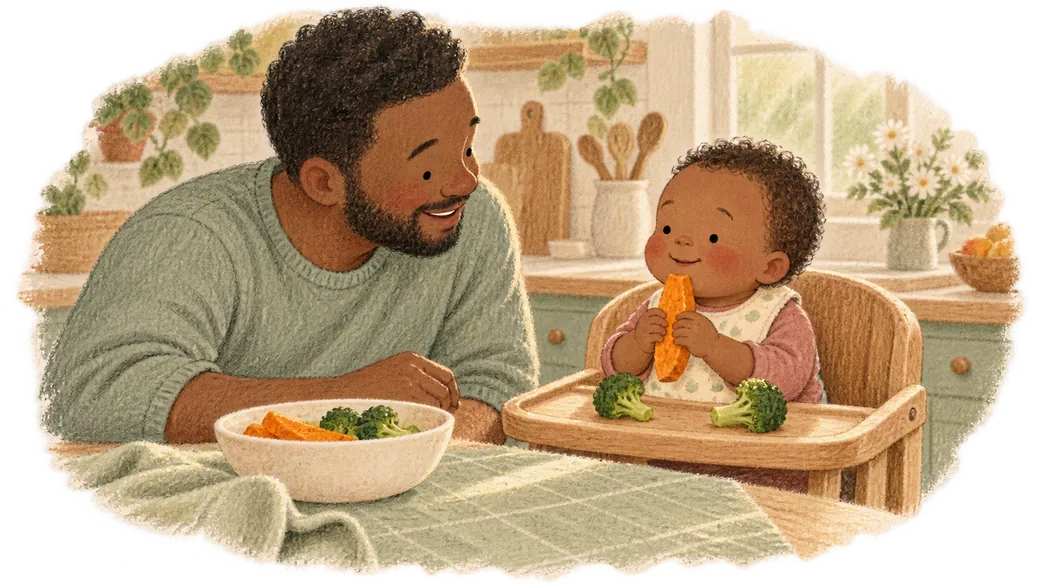
Quick answers
When should I start solids?
Around 6 months. That's the age the AAP, the NHS, the CDC and the WHO point to [1–4]. The CDC says introducing foods before 4 months is not recommended [3]. If your baby was born early, the NHS says to ask your doctor or health visitor when to start [2].
What are the signs my baby is ready?
The NHS describes three signs that appear together: your baby can stay sitting up and hold their head steady, can look at food, pick it up and put it in their mouth, and can swallow food rather than spit it back out [2]. The AAP and CDC list similar signs [1, 3]. More below.
Should I wait to give peanut or egg?
No. The AAP says there's no evidence that waiting to introduce foods such as egg, dairy, soy, peanut products or fish beyond 4 to 6 months prevents food allergy [1]. If your baby has severe eczema or an egg allergy, the AAP recommends testing for peanut allergy, and both the AAP and CDC say to talk to your child's doctor about how and when to give peanut [1, 3]. More below.
BabyTides app · coming to iPhone and Android
Keep track of feeds without the mental math
Log nursing, bottles and diapers in a tap. See when the last feed was and how the day added up.

- Feeds
- Diapers
- Weekly summary
Want paper for now? Print our free newborn log, no sign-up needed.
Not in the App Store or Google Play yet. We’ll email you when it opens.
When to start
The AAP recommends breast milk alone for about the first 6 months, and then supports continued breastfeeding along with first foods [1]. The NHS says solid foods should start when your baby is around 6 months old [2], and the CDC says children can begin eating solid foods at about 6 months [3]. The WHO's guideline describes complementary feeding as generally starting at 6 months [4].
Some sources leave a little room on timing. The AAP's page on starting solids also says that babies who have doubled their birth weight, typically at about 4 months, and weigh about 13 pounds (5.9 kg) or more may be ready [1]. A position paper from ESPGHAN, the European society of pediatric gastroenterology and nutrition, says solids shouldn't start before 17 weeks or later than 26 weeks [5]. The CDC is clear that foods before 4 months are not recommended [3].
For babies born prematurely, the NHS says to ask your health visitor or GP for advice on when to start [2]. In the US, ask your pediatrician.
Signs your baby is ready
The NHS says three signs usually appear together around 6 months. Your baby can [2]:
- stay in a sitting position and hold their head steady [2]
- coordinate their eyes, hands and mouth, so they can look at food, pick it up and put it in their mouth by themselves [2]
- swallow food, rather than spit it back out [2]
The AAP asks whether your baby can hold their head up and sit in a high chair or feeding seat with good head control, opens their mouth when food comes their way, and can move food from a spoon into their throat [1]. The CDC's list adds bringing objects to the mouth and trying to grasp small objects such as toys or food [3].
Some things that look like readiness aren't, according to the NHS: chewing fists, waking up in the night more than usual and wanting extra milk feeds are normal baby behaviors and not necessarily signs of hunger or readiness for solid food [2].
First foods and first weeks
The AAP says your baby's first foods are your choice, and that there's no evidence a baby will dislike vegetables if fruit comes first [1]. It does say to include foods that provide iron and zinc, such as baby food made with meat or iron-fortified cereal [1]. The NHS suggests mashed or soft-cooked sticks of vegetables and fruit, such as parsnip, broccoli, potato, sweet potato, carrot, apple or pear [2].
- Start small. The AAP suggests half a spoonful or less at first, talking to your baby as you go [1]. The NHS says that at the beginning your baby will only need a small amount of food before their usual milk feed, and doesn't need 3 meals a day [2]. By about 10 months, the NHS says, babies should be having 3 meals a day [2].
- One new food at a time. The AAP suggests introducing one single-ingredient new food every 3 to 5 days [1].
- Let them try. The NHS suggests letting your baby feed themselves with their fingers when they want to [2].
- Expect refusals. The NHS says it may take 10 tries or more for a baby to get used to new foods, flavors and textures, and not to force your baby to eat [2]. If your baby cries or turns away, the AAP says not to make them eat, and suggests going back to breast milk or formula alone for a while before trying again [1].
Within a few months of starting, the AAP says a baby's daily diet should include a variety of foods, such as breast milk, formula or both, meats, cereal, vegetables, fruits, eggs and fish [1].
Milk and other drinks
In the first months of solids, the AAP says your baby will still get most of their nutrition from breast milk, formula or both [1]. Our guide to how much babies eat covers milk feeds.
- Water. The NHS suggests introducing a cup from around 6 months and offering sips of water with meals [2]. The AAP says healthy babies don't need extra water, but that small amounts are fine once solids start, up to 1 cup (8 ounces) a day [1].
- Juice. The AAP says babies younger than 12 months shouldn't be given juice [1].
- Cow's milk. The NHS says cow's milk and other milks shouldn't be introduced as a main drink until 12 months [2]. The CDC says drinking cow's milk or fortified dairy alternatives isn't recommended until after 12 months [3].
- Rice drinks. The NHS says children under 5 shouldn't have rice drinks instead of breast milk or formula, because they may contain too much arsenic [6].
Peanut, egg and other allergenic foods
The AAP says there's no evidence that waiting to introduce baby-safe foods such as egg, dairy, soy, peanut products or fish beyond 4 to 6 months prevents food allergy [1]. The CDC says to introduce potentially allergenic foods when you introduce other foods [3]. The NHS says foods such as peanuts, hens' eggs, gluten and fish can be introduced from around 6 months, one at a time and in small amounts, so you can spot any reaction [2]. Once a food is introduced and tolerated, the NHS says it should become part of your baby's usual diet [7].
A key trial on peanut, called LEAP, assigned 640 babies aged 4 to 11 months with severe eczema, egg allergy or both to either eat peanut regularly or avoid it [8]. Among babies whose skin-prick test was negative at the start, 13.7% of those who avoided peanut had a peanut allergy at 5 years, compared with 1.9% of those who ate it [8].
If your baby has eczema or a food allergy
For babies with severe eczema, egg allergy or both, the AAP recommends testing for peanut allergy and says to check with your child's doctor about how and when to give peanut products [1]. The CDC also says to talk with your child's doctor or nurse about when and how to introduce foods with peanuts safely [3]. The NHS says that if your baby already has an allergy or eczema, or there's a family history of food allergy, eczema, asthma or hay fever, to talk to your GP or health visitor first [7].
Peanuts and other nuts need a safe form. The NHS says whole nuts shouldn't be given to children under 5 because of choking, and that nut butter shouldn't be given on its own [6]. The CDC lists chunks or spoonfuls of nut and seed butters as a choking hazard [9].
Gagging and choking
The NHS says choking is different from gagging, and that your baby may gag when you introduce solid foods [2]. It says to always stay with your baby while they're eating in case they start to choke, and to make sure they're sitting safely upright so they can swallow properly [2].
The AAP says to make sure anything you give your baby is soft, easy to swallow and cut into small pieces, and not to give food that requires chewing or could be a choking hazard [1]. Foods the AAP says to avoid under 1 year include [1]:
- hot dogs, including meat sticks [1]
- nuts and seeds, and chunks of peanut butter [1]
- chunks of meat or cheese [1]
- whole grapes [1]
- popcorn [1]
- raw vegetables and fruit chunks, such as apple chunks [1]
- hard, gooey or sticky candy [1]
The CDC's longer list also includes uncut cherry tomatoes, berries and melon balls, whole corn kernels, raisins, whole beans, and crackers or breads with seeds or whole grain kernels [9]. It says cutting food into smaller pieces and mashing it can help prevent choking [9].
Foods to avoid in the first year
- Honey. The CDC says not to feed honey to a child younger than 1 year old, because honey can contain the bacteria that cause botulism [10]. The NHS gives the same age limit [6].
- Salt and sugar. The NHS says not to add sugar or salt, including stock cubes and gravy, to your baby's food or cooking water [2].
- Cereal in a bottle. The AAP says not to put baby cereal in a bottle, unless your pediatrician recommends it, for example for reflux [1].
When to call the doctor or emergency services
Signs of an allergic reaction
The NHS says allergic reactions usually happen within a few minutes of a baby trying a new food, though some take longer [7]. Signs it lists include swollen lips or face, wheezing and coughing, a red, itchy rash, and being sick [7]. Talk to your pediatrician if you think your baby has reacted to a food.
Call 911 or your local emergency number
The NHS says a severe reaction called anaphylaxis is a medical emergency that needs urgent treatment, and that it can start quickly with breathing problems, a swollen throat or tongue, or a raised, itchy rash [7]. Its anaphylaxis page says to call for help if you think someone is having one (999 in the UK) [11]. Other signs it lists include [11]:
- difficulty breathing or breathing very fast [11]
- difficulty swallowing, or wheezing, coughing or noisy breathing [11]
- blue, gray or pale skin, lips or tongue (on brown or black skin, this may be easier to see on the palms or soles) [11]
In the US, the emergency number is 911. If your baby has been prescribed an adrenaline (epinephrine) auto-injector, the NHS says to use it [11].
Keeping a record
When new foods come one at a time, a quick note of what your baby tried and when makes it easier to spot a pattern, and to tell your pediatrician. BabyTides is being built to let you log solids alongside feeds, sleep and diapers. It can't tell you whether your baby has a food allergy.
Keep reading
 Feeding · 0–6 monthsHow much should my baby eat?How often and how much in the first months, breast or bottle, and the signs your baby is getting enough.
 Feeding · 0–24 monthsWater, juice and cow's milk: when can my baby have them?When water, cow's milk, juice and milk alternatives fit in from birth to age 2, per the CDC, AAP, NHS and ESPGHAN, and where they differ.
 Feeding · 6–24 monthsIs my baby gagging or choking?How the NHS and AAP tell gagging from choking, what the NHS says to do if a child chokes, and what studies of first foods found.
BabyTides is coming to iPhone and Android. Join the waitlist and we'll email you when it opens.
Join the waitlistSources
- American Academy of Pediatrics, HealthyChildren.org. Starting Solid Foods. Updated June 23, 2026.
- NHS. Your baby's first solid foods. Reviewed February 19, 2026.
- Centers for Disease Control and Prevention. When, What, and How to Introduce Solid Foods. April 14, 2026.
- World Health Organization. WHO Guideline for complementary feeding of infants and young children 6–23 months of age. October 16, 2023.
- Fewtrell M, Bronsky J, Campoy C, et al. Complementary feeding: a position paper by the European Society for Paediatric Gastroenterology, Hepatology, and Nutrition (ESPGHAN) Committee on Nutrition. Journal of Pediatric Gastroenterology and Nutrition. 2017;64(1):119–132.
- NHS. Foods to avoid giving babies and young children. Reviewed February 18, 2026.
- NHS. Food allergies in babies and young children. Reviewed October 22, 2024.
- Du Toit G, Roberts G, Sayre PH, et al. Randomized trial of peanut consumption in infants at risk for peanut allergy. New England Journal of Medicine. 2015;372(9):803–813.
- Centers for Disease Control and Prevention. Choking Hazards. March 11, 2026.
- Centers for Disease Control and Prevention. Preventing Botulism. February 26, 2026.
- NHS. Anaphylaxis. Reviewed June 21, 2023.
Sources checked October 29, 2026. Study details (sources 5 and 8) checked October 26, 2026.