 BabyTides™
Join the waitlist
Feeding · 0–6 months
How much should my baby eat?
Whether you breastfeed, use formula or do both, the first months come with a lot of questions about how often and how much. Here's what health organizations say is typical, how to read your baby's hunger and fullness cues, and the signs that your baby is getting enough.

How much should a 1-month-old eat?
If your baby takes formula, the AAP says that by the end of the first month most babies take 3 to 4 ounces (90 to 120 ml) or more per feed, about every 3 to 4 hours [1]. With breastfeeding you can't measure the amount, and you don't need to. The AAP describes breastfed newborns feeding about every 2 hours, around 10 to 12 times in 24 hours, and notes that the amount slowly increases over the first weeks [1]. The rest of this guide covers cues, amounts at other ages and signs your baby is getting enough. For more about this age, see your baby's first month.
BabyTides app · coming to iPhone and Android
Keep track of feeds without the mental math
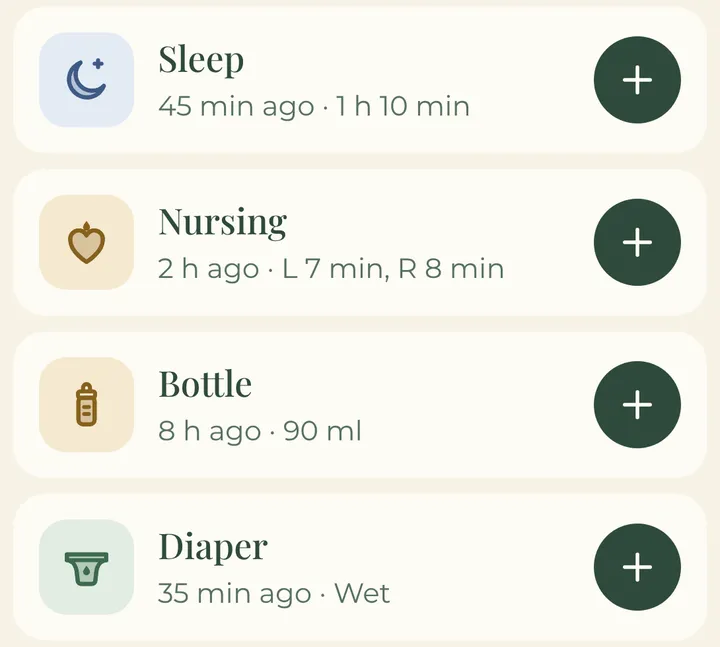
Log nursing, bottles and diapers in a tap. See when the last feed was and how the day added up.

- Feeds
- Diapers
- Weekly summary
Want paper for now? Print our free newborn log, no sign-up needed.
Not in the App Store or Google Play yet. We’ll email you when it opens.
Your baby is the best guide
Numbers can be reassuring, but every baby is different, and the amount a baby takes can change from feed to feed. Health organizations agree on the main idea: watch your baby, feed when they show they're hungry, and let them stop when they're full [2, 4, 5]. The figures below are rough guides, not targets.
How often newborns feed
Young babies have small tummies and feed often, day and night.
- Breastfed newborns often feed about every 2 hours, counted from the start of one feed to the start of the next, which adds up to about 10 to 12 feeds in 24 hours, according to the AAP [1]. The NHS puts it more simply: feed as often and for as long as your baby wants [4].
- Formula-fed newborns usually feed every 2 to 3 hours, about 8 to 12 times in 24 hours [1, 2].
Over the following weeks, feeds usually spread out. Many formula-fed babies feed about every 3 to 4 hours once they're past the first weeks [2].
How much formula
If your baby is formula-fed, the table below shows the typical amounts per feed that the AAP and CDC describe. One ounce is about 30 ml.
These are general guides for healthy babies born at full term. They aren't meant for bottles of expressed breast milk, or for working out top-ups if you combine breastfeeding and formula. If your baby was born early, is having trouble gaining weight, or has a feeding plan from their doctor, follow your doctor's advice [1].
| Age | Typical amount of formula per feed |
|---|---|
| First day or two | About half an ounce (15 ml) [1] |
| First days and weeks | 1 to 2 ounces (30 to 60 ml), every 2 to 3 hours [1, 2] |
| Around 1 month | Most babies take about 3 to 4 ounces (90 to 120 ml), sometimes more, about every 3 to 4 hours [1] |
| Around 6 months | 6 to 8 ounces (180 to 240 ml), 4 or 5 times a day [1]. As solid foods start, the pattern of feeds may shift [2]. |
These numbers are a rough guide, not a portion your baby has to finish. Babies generally take what they need and stop when they're full [2]. Don't push your baby to finish the bottle or to take more than they want [8]. The AAP suggests offering a little less, since you can always give more if your baby still seems hungry [1]. It's normal for some bottles to go unfinished [5, 8], and a bigger feed doesn't always mean a longer gap before the next one [5]. If you're unsure how much is right for your baby, ask your pediatrician [1].
With breastfeeding, you can't see how much your baby takes, and that's fine. The signs further down tell you more than any number would.
Signs your baby is hungry
Babies show hunger before they cry. Feeding at these early cues can be calmer for both of you, because a crying baby can find it hard to settle and eat [1]. Common hunger cues include [1, 3]:
- bringing hands to the mouth
- turning toward the breast or bottle, or rooting
- puckering, smacking or licking the lips
- clenched hands
Crying is often a late sign of hunger [1, 3]. If your baby is already crying, that's common and it doesn't mean you missed something. Calming them a little first can make the feed easier [1].
Signs your baby is full
Common fullness cues include [3]:
- closing the mouth
- turning the head away from the breast or bottle
- relaxed, open hands
Bottle-fed babies don't always show clearly that they're full [1]. Pausing during the feed gives your baby a chance to show whether they want more [1].
Is my baby getting enough?
Diapers and weight are the most useful signs, whatever way you feed [1, 4].
- Wet diapers. In the first 48 hours, many babies have only 2 or 3 wet diapers in total [4]. From day 5, wet diapers become more frequent: at least 6 heavy, wet diapers every 24 hours [4].
- Poops. How often varies, and breastfed and formula-fed babies differ [1]. For breastfed babies, the NHS describes at least 2 soft, yellow poops a day from about day 4, for the first few weeks [4].
- Weight. Some weight loss in the first days is normal [4]. After that, steady weight gain at your baby's checkups is a good sign [1, 4].
- Behavior. A baby who seems content after most feeds and alert when awake is likely feeding well [4].
If you're breastfeeding and worried about your milk supply, ask for help early. A lactation consultant or breastfeeding specialist (in the UK, also your midwife or health visitor) can watch a feed and help [4]. Your pediatrician is there for these questions too.
When to call your pediatrician
Call your pediatrician right away if your baby has signs of dehydration, such as:
- fewer wet diapers than usual, or fewer than 6 a day after day 5 [4, 6, 7]
- a dry mouth, or few or no tears when crying [6, 7]
- a sunken soft spot on the head, or sunken eyes [6, 7]
- playing or feeding less than usual [6]
- being very fussy or much sleepier than usual [6, 7]
Call 911 or your local emergency number if your baby is hard to wake, has blue, gray, pale or blotchy skin, lips or tongue, or is having trouble breathing [7].
Also talk to your pediatrician if you have questions about how often or how much your baby eats, if your baby seems to want to eat all the time even after full feeds, or if your baby is having trouble gaining weight [1].
Writing it down helps
In the blur of the first weeks, it's hard to remember when the last feed was, which side you finished on, or how many wet diapers there have been today. That's what BabyTides will help with: breast and bottle feeds, timers for each side and diapers in a tap or two, with day and week reports you can show your pediatrician. It won't tell you how much your baby should eat, because your baby and your doctor know that best.
Feeds and sleep shape each other in the early weeks. See our guide to baby sleep by age.
Keep reading
 Feeding · 0–4 monthsGrowth spurts and cluster feeding: what's normal?Why babies sometimes feed almost nonstop, what research shows about growth spurts, and signs your baby is getting enough.
 Feeding · 4–12 monthsStarting solids: when and howWhen to start, signs of readiness, first foods, peanut and egg, choking and foods to avoid, from the AAP, NHS, CDC and WHO.
 Feeding · 0–24 monthsWater, juice and cow's milk: when can my baby have them?When water, cow's milk, juice and milk alternatives fit in from birth to age 2, per the CDC, AAP, NHS and ESPGHAN, and where they differ.
BabyTides is coming to iPhone and Android. Join the waitlist and we'll email you when it opens.
Join the waitlistSources
- American Academy of Pediatrics, HealthyChildren.org. How Often and How Much Should Your Baby Eat? Updated April 2, 2024.
- Centers for Disease Control and Prevention. How Much and How Often to Feed Infant Formula. Reviewed April 21, 2026.
- Centers for Disease Control and Prevention. Signs Your Child Is Hungry or Full. Reviewed March 11, 2026.
- NHS. Breastfeeding: is my baby getting enough milk? Reviewed April 30, 2026.
- NHS. Formula milk: common questions. Reviewed September 8, 2023.
- American Academy of Pediatrics, HealthyChildren.org. Signs of Dehydration in Infants & Children. Updated September 24, 2019.
- NHS. Dehydration. Reviewed May 1, 2026.
- NHS. Bottle feeding advice. Reviewed April 2, 2024.
Sources checked October 17, 2026. Source 1 rechecked October 27, 2026.