 BabyTides™
Join the waitlist
Health · 0–24 months
Eczema in babies: what helps and when to call
What the American Academy of Pediatrics (AAP), the NHS and the UK's National Institute for Health and Care Excellence (NICE) say about eczema in babies: where it shows up, the daily skin care they describe, steroid creams, food and allergy, what prevention trials found, and which signs mean it's time to call. This article summarizes guidance from health organizations and published research; it isn't personal medical advice.
Quick answers
Will my baby grow out of eczema?
The NHS says symptoms usually start in babies and young children and tend to get better with age, though there is no cure [3]. The AAP says that for some children it fades by about age 4, others keep dry, sensitive skin into adulthood, and it's hard to predict which [1].
Is baby eczema caused by food?
The AAP says food allergies are common in children with eczema, but food isn't what causes eczema [1]. The NHS says not to change your diet unless a doctor tells you to, including if you're breastfeeding a baby with eczema [3].
Is eczema contagious?
No. Both the AAP and the NHS say eczema is not contagious [1, 3].
BabyTides app · coming to iPhone and Android
Keep a simple record for your pediatrician
Log temperatures, feeds, diapers and notes in a few taps. Look back at the days together if you need to call.

- Temperatures
- Notes
- Weekly summary
Want paper for now? Print our free newborn log, no sign-up needed.
Not in the App Store or Google Play yet. We’ll email you when it opens.
What eczema is
The AAP describes eczema, also called atopic dermatitis, as a long-term skin condition that causes dry, red, itchy patches, and says it affects up to 1 in 4 children [1]. The NHS calls atopic eczema a common condition that causes itchy skin and says it's most common in young children [3].
On the cause, the AAP links eczema to the skin barrier: many children with it have too little of a protein called filaggrin in the outer layer of skin, so the skin holds water less well and lets bacteria and irritants in more easily [1]. The AAP says genes and environment both play a part and that it often runs in families [1]. The NHS says the exact cause isn't always known, and that it's more likely if a parent has atopic eczema, or if a close relative has asthma or hay fever [3].
Where it shows up in babies
According to the AAP, eczema in babies usually starts on the scalp and face, including the cheeks, forehead and around the mouth, and it usually doesn't appear in the diaper area [1]. The NHS says that in babies and toddlers it's common on the face [3].
The NHS lists itchy skin; dry, cracked, crusty, scaly or thickened skin; redness or discoloration, which looks different on different skin tones; and sometimes blistering or bleeding [3].
For a rash that starts in the diaper area, see diaper rash: causes, care and when to call. For greasy, yellow scales on the scalp, see cradle cap: what it is, what helps and when to call.
Daily skin care the guidance describes
The AAP describes this routine [2]:
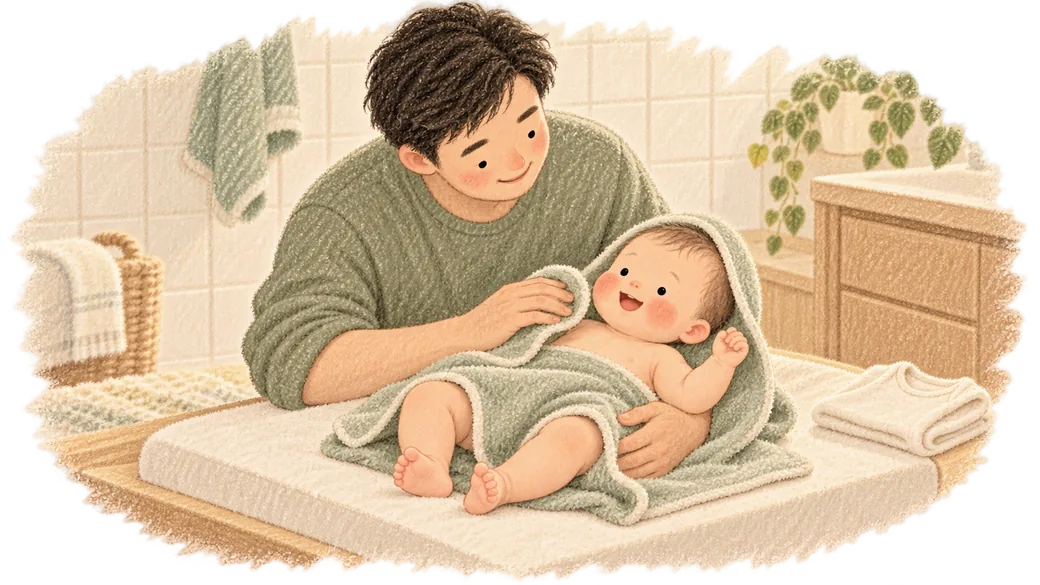
- Bathe your child every day or every other day, for 5 to 10 minutes, in lukewarm water [2].
- Soap isn't needed. A gentle, fragrance-free cleanser can be used on sweaty areas and on the hands and feet. Don't scrub or add bubble bath, and pat the skin dry [2].
- Put moisturizer on the whole body right after the bath, while the skin is still damp [2].
- The AAP says creamier moisturizers work better. It names ointments such as petroleum jelly, or fragrance-free creams, and calls lotions thinner and less effective [2].
- Moisturize once or twice a day, and keep going after the rash clears [2].
- Dress your child in soft fabrics such as 100% cotton, use a mild, fragrance-free detergent, and skip fabric softener and dryer sheets [2].
- Keep nails short; the AAP says cotton gloves at night can also help [2].
The NHS says to apply emollients (moisturizers) at least twice a day, keep using them when the skin improves, and wash with an emollient instead of soap [3]. It says to avoid aqueous cream, which can irritate the skin [3].
NICE's guidance for families says emollients should be used as often and as generously as possible, even when the eczema has cleared, and should be smoothed on rather than rubbed in [4]. It says to use them instead of soap, bubble bath and shower gel, and instead of shampoo for children under 1 year [4]. NICE says children with eczema should be prescribed 250 g to 500 g of unperfumed emollient a week (about 9 to 18 ounces) [5].
The NHS also warns that emollients can make clothing, bedding and dressings catch fire more easily, and says not to smoke or go near naked flames when using them [3].
The AAP says triggers differ from child to child and lists some of them, including dust mites, fragrances, heat and sweat, hormones, insect bites and stings, pet dander, pollen, tobacco smoke, and wool and synthetic fabrics [2]. The NHS list includes soap, washing detergent, certain foods, heat and skin infections [3].
Flares and steroid creams
The AAP says prescription steroid creams are used to heal irritated eczema rashes, are usually applied twice a day during a flare, and that your doctor chooses the strength and form [2]. If a medicine is prescribed, the AAP says to put it on the rash before the moisturizer [2]. Once the itch is gone and the skin is smooth and soft, the AAP says medicines can be used less often, while daily gentle skin care continues [2].
NICE says steroid creams or ointments are usually used once or twice a day on areas that are active or have been active in the last 48 hours, that flare treatment should start as soon as symptoms appear and continue for at least 48 hours after the flare stops, and that potent steroids for children under 12 months should be supervised by a specialist [4]. NICE also says to leave at least a few minutes between different treatments [4].
The AAP also describes non-steroid prescription creams, wet wraps, and diluted bleach baths, which it says can help prevent skin infections [2]. The NHS page doesn't mention bleach baths [3].
Food, allergy and eczema
The AAP says food can rarely trigger flares, and to talk to your doctor before making restrictive changes to your child's diet [2]. The NHS says not to change your diet unless a doctor tells you to, including when breastfeeding a baby with eczema [3].
For bottle-fed babies under 6 months, NICE says a trial of cow's milk-free formula may be offered, and that it shouldn't be soya-based or made from goat's or sheep's milk [4].
On peanut, the AAP says babies with severe eczema and/or egg allergy should get peanut products between 4 and 6 months, that peanut allergy testing is recommended for them, and that parents should talk with their pediatrician early, such as at the 2- or 4-month checkup, about how and when to give peanut [8].
Where the advice differs
The AAP, the NHS and NICE all describe moisturizing that continues after the skin improves, washing without soap, and prescription steroid creams [2, 3, 4]. Some details differ:
| Topic | AAP (US) | NHS and NICE (UK) |
|---|---|---|
| How often to moisturize | Once or twice a day, right after the bath [2]. | At least twice a day (NHS) [3]; as often and as generously as possible (NICE) [4]. |
| Washing | Lukewarm bath for 5 to 10 minutes, daily or every other day; a gentle, fragrance-free cleanser for some areas [2]. | Wash with an emollient instead of soap [3]; emollient instead of shampoo under age 1 [4]. |
| Amount | No amount given on the pages we reviewed [1, 2]. | 250 g to 500 g a week, prescribed (NICE) [5]. |
| Bleach baths | Described, 2 to 3 times a week, to help prevent infection [2]. | Not mentioned on the NHS page [3]. |
Can moisturizing a newborn prevent eczema?
The BEEP trial, published in The Lancet in 2020, randomized 1,394 newborns in the UK who had a parent or sibling with eczema, hay fever or asthma [6]. Half got daily emollient for the first year plus standard skin-care advice; half got the advice alone [6]. At age 2, eczema was found in 23% of the emollient group and 25% of the comparison group, a difference the authors said gave no evidence of prevention [6]. The emollient group had more skin infections in the first year [6]. The authors concluded that families with eczema, asthma or hay fever should not use daily emollients to try to prevent eczema in their newborns [6].
A 2021 Cochrane review with individual participant data, by Kelleher and colleagues, pooled trials of skin care in healthy infants [7]. It found that regular emollients in infancy probably make little or no difference to eczema at 1 to 3 years, and probably increase local skin infections, both with moderate certainty [7]. Whether they change the risk of food allergy was unclear, based on very low-certainty evidence from a single trial [7].
These studies looked at preventing eczema in babies without it. NICE's emollient advice above is about treating eczema that a child already has [4, 5].
When to call the doctor
The AAP says to contact your pediatrician if [1, 2]:
- the skin has yellow or honey-colored crusts, scabs, weeps or oozes, or has blisters or pus-filled bumps [1, 2]
- the rash isn't improving, or is getting worse, with the usual treatments [1, 2]
In the UK, the NHS says to ask for an urgent GP appointment or get help from NHS 111 if [3]:
- the skin has blisters, crusts, leaking fluid or pus-filled spots [3]
- it's painful, swollen or feels warm [3]
- it suddenly gets worse or spreads [3]
- your child has a high temperature or feels generally unwell [3]
The NHS says these signs can mean an infection or eczema herpeticum, a more serious condition [3]. For a child under 5, it says to call 111 [3]. It also says to see a GP if your child has symptoms of eczema, or if treatments aren't helping [3].
For temperatures by age, see fever in babies: when to call the doctor.
Keeping a record
The AAP says to call about a rash that isn't improving with the usual treatments [1], and the NHS says to see a GP if treatments aren't helping [3].
BabyTides is being built for parents who want to keep notes. You'll be able to log diapers, feeds and sleep in a tap. It doesn't diagnose skin conditions, and it can't tell you whether your baby needs to see a doctor.
Keep reading
 Health · 0–24 monthsRSV and bronchiolitis in babies: what health organizations saySymptoms, how long it lasts, care at home, US and UK protection options, and when to call, from the AAP, CDC, NHS and NICE.
 Health · 0–24 monthsHow can I help a baby with a cold or stuffy nose?Saline drops, suction, fluids, cough and cold medicine age limits in the US and UK, and when to call, from the AAP, FDA and NHS.
 Health · 0–12 monthsSpit-up and reflux: what's normalHow common spit-up is, when it eases, feeding tips, thickeners and medicines in the US and UK, safe sleep and when to call, from the AAP, NHS and NICE.
BabyTides is coming to iPhone and Android. Join the waitlist and we'll email you when it opens.
Join the waitlistSources
- Stein S; American Academy of Pediatrics Section on Dermatology, HealthyChildren.org. Eczema in Babies and Children: Symptoms and Causes. Updated May 19, 2025.
- Stein S, Maguiness S; American Academy of Pediatrics Section on Dermatology, HealthyChildren.org. How to Treat & Control Eczema (Atopic Dermatitis) Rashes in Children. Updated May 14, 2025.
- NHS. Atopic eczema. Reviewed September 6, 2024. Includes the treatment and urgent-advice sections.
- National Institute for Health and Care Excellence (NICE). Treating your child's atopic eczema (information for the public, guideline CG57).
- National Institute for Health and Care Excellence (NICE). Atopic eczema in under 12s, quality statement 4: provision of emollients (QS44). Published September 5, 2013; last updated May 2025.
- Chalmers JR, Haines RH, Bradshaw LE, et al. Daily emollient during infancy for prevention of eczema: the BEEP randomised controlled trial. The Lancet. 2020;395(10228):962-972. doi:10.1016/S0140-6736(19)32984-8.
- Kelleher MM, Cro S, Van Vogt E, et al. Skincare interventions in infants for preventing eczema and food allergy: a Cochrane systematic review and individual participant data meta-analysis. Clinical & Experimental Allergy. 2021;51(3):402-418. doi:10.1111/cea.13847.
- McCarthy C; American Academy of Pediatrics, HealthyChildren.org. Peanut Allergy: What to Know About the Latest Prevention Guidelines. Updated January 6, 2024.
Sources checked October 30, 2026.