 BabyTides™
Join the waitlist
Development · 0–12 months
Cooing and babbling: how talking starts in the first year
Long before first words, babies coo, squeal and babble. Here's when those sounds usually come according to the CDC and the AAP, what researchers have learned from babbling, what the AAP and NHS suggest to help, and when to check hearing or talk to your pediatrician.
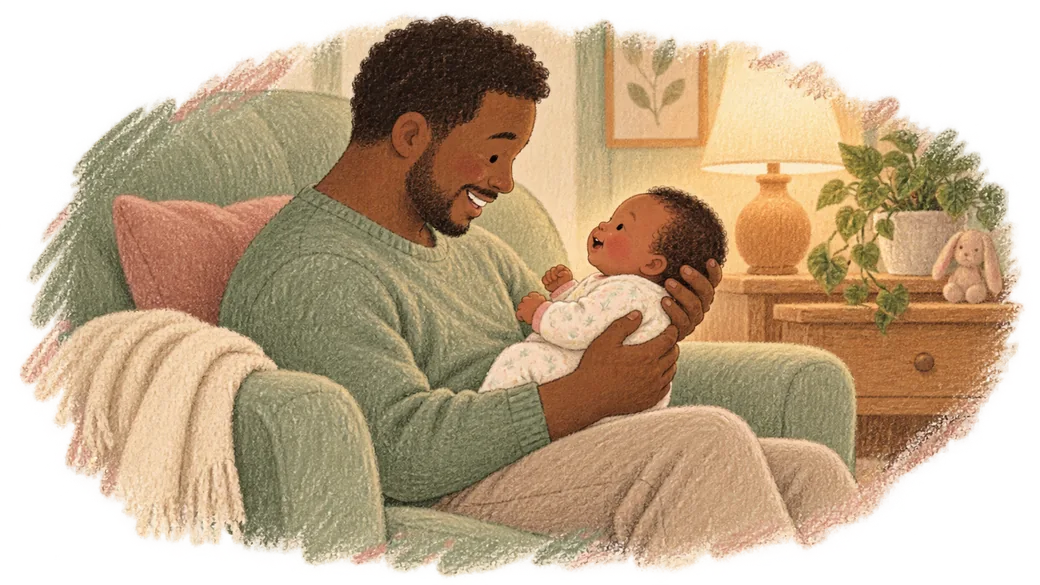
Quick answers
When do babies start cooing?
The AAP says that at about 2 months, babies may begin cooing and repeating some vowel sounds [6]. The CDC's checklists say most babies make sounds other than crying by 2 months [1], and coo, with sounds like "oooo" and "aahh," by 4 months [2].
When do babies babble?
The AAP says babies start to babble at about 4 months [6, 7]. The CDC's checklists say most babies blow raspberries and squeal by 6 months [3], and make lots of different sounds like "mamamama" and "babababa" by 9 months [4].
When should I worry about babbling?
The AAP says that if a baby doesn't babble or imitate any sounds by 7 months, it could mean a problem with hearing or speech development, and that you should let your pediatrician know if your baby doesn't babble or make a variety of sounds [7]. More below.
BabyTides app · coming to iPhone and Android
Note the firsts as they happen
Mark milestones when you see them and add a note in your own words. Look back at them any time.

- Milestones
- Notes
- Weekly summary
Want paper for now? Print our free newborn log, no sign-up needed.
Not in the App Store or Google Play yet. We’ll email you when it opens.
Sounds month by month
These are skills the CDC's checklists say most babies have by each age [1–5]. Many babies get there sooner.
| By | Most babies |
|---|---|
| 2 months | make sounds other than crying and react to loud sounds [1] |
| 4 months | coo ("oooo," "aahh") and make sounds back when you talk to them [2] |
| 6 months | take turns making sounds with you, blow raspberries and squeal [3] |
| 9 months | make lots of different sounds like "mamamama" and "babababa," and lift their arms up to be picked up [4] |
| 1 year | wave bye-bye, call a parent "mama," "dada" or another special name, and understand "no" [5] |
The AAP adds that babies recognize and respond to the voices they hear most [6], and that their babbling uses many of the rhythms of the language spoken around them [7]. After the first birthday, see first words.
What babbling tells researchers
Researchers pay special attention to "canonical" babbling: strings of real syllables, such as "bababa," rather than single vowel sounds. A study that recorded babies all day describes canonical babbling as coming before first words and predicting later language development [12]. A 2019 review found that babies later diagnosed with some developmental conditions were less likely to babble this way, and when they did, often started later than the usual window of about 5 to 10 months [10]. The authors note that there are few studies and their methods vary [10]. Babbling late doesn't mean a baby has a condition; it's one of several things worth mentioning to your pediatrician.
The back-and-forth matters too. In a study that followed babies from 11 months, sounds babies made while looking at an adult, as if to communicate, were the best predictors of their vocabulary up to 24 months, and adults were more likely to respond to them [11].
What helps
- Talk through the day. The NHS suggests chatting about what you're doing as you feed, change and bathe your baby [8]. The AAP suggests talking to your baby throughout the day [7].
- Copy their sounds. The NHS suggests repeating the sounds your baby makes back to them [8]. The AAP suggests imitating their cooing while adding simple words, and repeating recognizable syllables back to them [6, 7].
- Sing and read. The NHS suggests singing and looking at books together [8], and the AAP suggests reading to your baby from early on [6].
- Turn off background noise. The NHS suggests switching off the TV and radio, because background noise makes it harder for your child to listen to you [8].
- Pacifiers for sleep. The NHS suggests offering a pacifier only when it's time for sleep, and aiming to stop using pacifiers completely by 12 months [8].
Hearing checks
Hearing and early sounds go together. The AAP says all newborns should be tested for hearing loss [7]. The CDC says newborn hearing screening should happen no later than 1 month of age, and that if a baby doesn't pass, a full hearing test should follow as soon as possible and no later than 3 months [9].
The CDC says that if you think a child might have hearing loss, ask the doctor for a hearing test as soon as possible [9]. The AAP notes that a baby with partial hearing loss may still startle at loud noises, but will have difficulty imitating speech [7].
When to talk to your pediatrician
The AAP says to let your pediatrician know if your baby doesn't babble or make a variety of sounds, and that not babbling or imitating any sounds by 7 months could mean a problem with hearing or speech development [7]. If you suspect a hearing problem, it suggests asking for a referral to a children's hearing specialist [7].
The CDC says to talk with your child's doctor and ask about developmental screening if your child isn't meeting one or more milestones, has lost skills they once had, or you have other concerns, and not to wait [13].
In the UK, the NHS suggests talking to your GP or health visitor if you're worried about your child's speech or language [8].
Keeping a record
BabyTides is being built with a milestones section based on the CDC's checklists, where you can note the first coo, the first "bababa" and the first wave. It isn't a test, and it can't tell you whether your baby's development is on track; your pediatrician can.
Keep reading
 Development · 0–6 monthsTummy time: when to start and how to make it easierHow much tummy time babies need, why it helps, and what to try if your baby protests.
 Development · 2–12 monthsRolling, sitting and crawling: when babies usually do itWhen babies roll, sit and crawl, why the CDC, AAP and WHO give different ages, and when to talk to your pediatrician.
 Development · 8–18 monthsFirst steps and walking: when babies usually startWhen babies take first steps, how wide the normal range is, why walkers are a bad idea, and when to talk to your pediatrician.
BabyTides is coming to iPhone and Android. Join the waitlist and we'll email you when it opens.
Join the waitlistSources
- Centers for Disease Control and Prevention. Milestones by 2 Months. Updated May 16, 2026.
- Centers for Disease Control and Prevention. Milestones by 4 Months. Updated May 16, 2026.
- Centers for Disease Control and Prevention. Milestones by 6 Months. Updated May 16, 2026.
- Centers for Disease Control and Prevention. Milestones by 9 Months. Updated May 16, 2026.
- Centers for Disease Control and Prevention. Milestones by 1 Year. Updated May 16, 2026.
- American Academy of Pediatrics, HealthyChildren.org. Hearing & Making Sounds: Your Baby's Milestones. Updated February 22, 2021.
- American Academy of Pediatrics, HealthyChildren.org. Language Development: 4 to 7 Months. Updated August 1, 2009.
- NHS. Help your baby learn to talk. Reviewed April 26, 2023.
- Centers for Disease Control and Prevention. Screening for Hearing Loss. October 8, 2024.
- Lang S, Bartl-Pokorny KD, Pokorny FB, et al. Canonical babbling: a marker for earlier identification of late detected developmental disorders? Current Developmental Disorders Reports. 2019;6(3):111–118.
- Donnellan E, Bannard C, McGillion ML, et al. Infants' intentionally communicative vocalizations elicit responses from caregivers and are the best predictors of the transition to language: a longitudinal investigation of infants' vocalizations, gestures and word production. Developmental Science. 2020;23(1):e12843.
- Lee CC, Jhang Y, Relyea G, et al. Babbling development as seen in canonical babbling ratios: a naturalistic evaluation of all-day recordings. Infant Behavior and Development. 2018;50:140–153.
- Centers for Disease Control and Prevention. CDC's Developmental Milestones. Updated February 16, 2026.
Sources 1 to 9 and 13 checked October 29, 2026. Study details (sources 10 to 12) checked October 27, 2026.