 BabyTides™
Join the waitlist
Development · 8–18 months
First steps and walking: when babies usually start
When babies usually take their first steps and start walking on their own, according to the AAP, the CDC and a large WHO study. How wide the normal range is, why the AAP warns against baby walkers, and when it's worth talking to your pediatrician.
Quick answers
When do babies start walking?
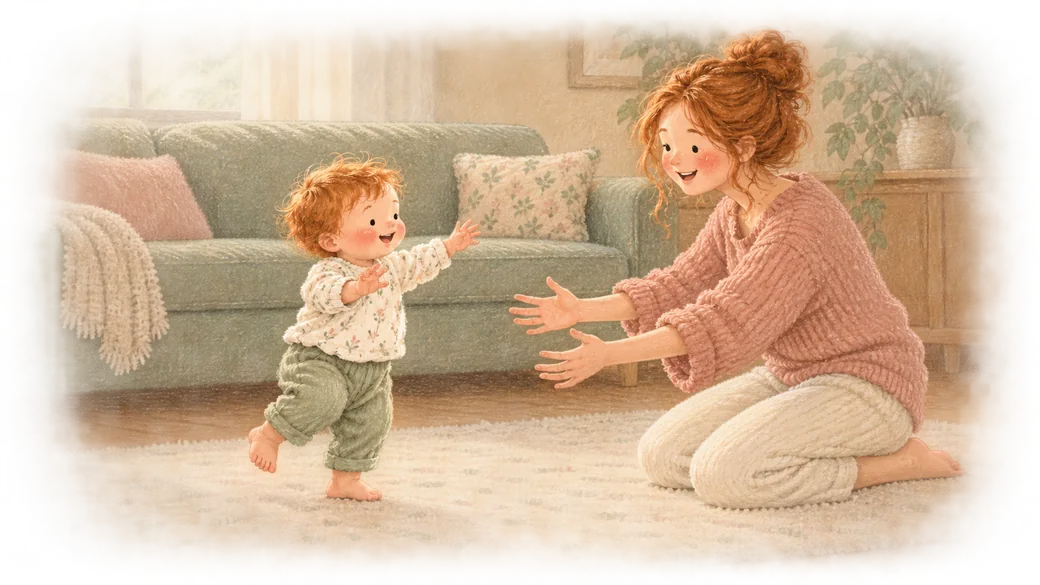
The AAP says many babies take their first steps around their first birthday [4]. The CDC's checklists say most children take a few steps on their own by 15 months [2] and walk without holding on to anyone or anything by 18 months [3]. In a large WHO study, almost all healthy babies started walking alone somewhere between about 8 and almost 18 months [6].
Is it a problem if my baby isn't walking at 12 months?
Not on its own. The CDC's 1-year checklist lists pulling up to stand and walking while holding on to furniture, not walking alone [1]. If your child isn't walking without holding on by 18 months, or you have other concerns, talk to your pediatrician [1, 3, 9].
Do baby walkers help babies walk?
No. The AAP strongly urges parents not to use walkers [4] and says they can actually delay walking [5]. The CDC says baby walkers are not recommended [1]. More below.
BabyTides app · coming to iPhone and Android
Note the firsts as they happen
Mark milestones when you see them and add a note in your own words. Look back at them any time.

- Milestones
- Notes
- Weekly summary
Want paper for now? Print our free newborn log, no sign-up needed.
Not in the App Store or Google Play yet. We’ll email you when it opens.
On the way to walking
Walking usually comes after a run of other skills. Around 8 to 12 months, the AAP describes babies pulling themselves up to stand every chance they get, and then cruising along furniture [4]. The CDC's 1-year checklist includes pulling up to stand and walking while holding on to furniture [1].
For the earlier steps, rolling, sitting and crawling, see when babies roll, sit and crawl.
The normal range is wide
The WHO followed healthy babies in several countries and reported the age windows in which almost all of them (from the 1st to the 99th percentile) reached each skill [6]:
| Skill | Age window in the WHO study |
|---|---|
| Walking with support | 5.9 to 13.7 months [6] |
| Standing alone | 6.9 to 16.9 months [6] |
| Walking alone | 8.2 to 17.6 months [6] |
That's why different sources give different ages. The AAP describes the typical age, around the first birthday [4]. The CDC lists the age by which most children can do something: 18 months for walking without holding on [3].
If your baby was born early, the AAP recommends using corrected age, counted from the due date, during the first 2 years [10].
Lots of steps, lots of falls
Learning to walk takes a lot of practice. In a US study that watched children aged 12 to 19 months during free play, they took an average of 2,368 steps and fell 17 times an hour [7]. As children got more experienced at walking, they fell less [7].
Why the AAP warns against baby walkers
The AAP strongly urges parents not to use baby walkers [4]. On its page about walkers, it says [5]:
- a child in a walker can move more than 3 feet in 1 second [5]
- children in walkers can roll down the stairs, which often causes broken bones and severe head injuries [5]
- a child in a walker can reach higher, which makes burns and poisoning easier [5]
- walkers can actually delay when a child starts to walk [5]
- baby walkers are banned in Canada [5]
A US study of emergency department data estimated that about 230,676 children under 15 months were treated for walker-related injuries between 1990 and 2014 [8]. Most of the injuries, 90.6%, were to the head or neck, and 74.1% came from falling down stairs in the walker [8]. Injuries dropped by 22.7% after a mandatory US safety standard for walkers began in 2010, but they still happen [8].
As an alternative, the AAP mentions stationary activity centers, which look like walkers but have no wheels [5].
Shoes and safety at home
For shoes, the AAP says they should be closed-toe, comfortable and flexible, with nonskid soles [4]. It suggests sturdy gates at the top and bottom of your stairs [4].
When to talk to your pediatrician
The CDC says to talk with your child's doctor and ask about developmental screening if your child isn't meeting one or more milestones, has lost skills they once had, or you have other concerns, and not to wait [9]. On the CDC's checklists, walking without holding on is an 18-month milestone [3].
The AAP says that if you feel your child isn't moving normally, you should discuss it with your pediatrician [4].
The AAP recommends developmental screening for all children at 9, 18 and 30 months, the CDC notes [9].
Keeping a record
BabyTides is being built with a milestones section based on the CDC's checklists, where you can note the day of those first steps. It isn't a test, and it can't tell you whether your child's development is on track; your pediatrician can.
Keep reading
 Development · 12–24 monthsFirst words: how talking develops from 12 to 24 monthsWhat the CDC lists for 1 year to 2 years, everyday ways to help, and when to talk with your pediatrician.
 Development · 2–12 monthsRolling, sitting and crawling: when babies usually do itWhen babies roll, sit and crawl, why the CDC, AAP and WHO give different ages, and when to talk to your pediatrician.
 Development · 0–12 monthsCooing and babbling: how talking starts in the first yearWhen babies coo and babble, what helps, hearing checks, and when to talk to your pediatrician.
BabyTides is coming to iPhone and Android. Join the waitlist and we'll email you when it opens.
Join the waitlistSources
- Centers for Disease Control and Prevention. Milestones by 1 Year. Updated May 16, 2026.
- Centers for Disease Control and Prevention. Milestones by 15 Months. Updated May 16, 2026.
- Centers for Disease Control and Prevention. Milestones by 18 Months. Updated May 16, 2026.
- American Academy of Pediatrics, HealthyChildren.org. Movement Milestones in Babies 8 to 12 Months Old. Updated April 7, 2021.
- American Academy of Pediatrics, HealthyChildren.org. Baby Walkers: A Dangerous Choice. Updated August 15, 2022.
- WHO Multicentre Growth Reference Study Group. WHO Motor Development Study: windows of achievement for six gross motor development milestones. Acta Paediatrica Supplement. 2006;450:86–95.
- Adolph KE, Cole WG, Komati M, et al. How do you learn to walk? Thousands of steps and dozens of falls per day. Psychological Science. 2012;23(11):1387–1394.
- Sims A, Chounthirath T, Yang J, et al. Infant walker–related injuries in the United States. Pediatrics. 2018;142(4):e20174332.
- Centers for Disease Control and Prevention. CDC's Developmental Milestones. Updated February 16, 2026.
- American Academy of Pediatrics, HealthyChildren.org. Corrected Age For Preemies. Updated December 10, 2018.
Sources 1 to 5, 9 and 10 checked October 29, 2026. Study details (sources 6 to 8) checked October 27, 2026.