 BabyTides™
Join the waitlist
Health · 0–2 months
Bathing your newborn and caring for the umbilical cord stump
In the first weeks, most babies need only gentle washes—not a daily tub dunk. Keep the cord stump clean and dry, never leave a baby alone in water, and know which skin changes mean a call. [1] [2] [3]
This guide offers general information. It is not a substitute for care from your baby’s clinician. For fever, poor feeding, or other urgent newborn signs, see Newborn: when to call the pediatrician. [2] [4]
Quick answers
Can I bathe my baby before the umbilical cord falls off?
The AAP advises sponge baths only until the stump falls off and the area has healed, then you can try a tub bath. The NHS describes topping and tailing with a bowl of warm water and says you only need to wash around the cord if it is dirty with pee or poo. [1] [2] [3]
How should I care for the cord stump?
Keep it clean and dry. Fold the diaper below the stump so urine does not soak it. The AAP says there is no need to use alcohol on the stump. A few drops of blood on the diaper around the time it falls off can be normal; active bleeding needs a call right away. [2]
How warm should the bath water be?
Both AAP and NHS say the bath water should feel warm—not hot—on the inside of your wrist or elbow. The AAP recommends filling about 2 inches of water. The NHS advises running cold water first, then adding hot, and mixing so there are no hot patches. Separately from the bath itself, the AAP recommends setting the hottest faucet temperature in your home no higher than 120°F (about 49°C)—that is a water-heater / faucet limit, not the target temperature of the bath water. [1] [3]
When should the stump fall off, and when do I call?
On the AAP bathing page, the stump usually falls by about one or two weeks of age; the AAP cord-care page says it should dry and fall by 3 weeks—if it remains beyond that, a doctor visit is needed. Call for foul-smelling yellowish discharge, red skin around the base, pain when the area is touched, or active bleeding. [1] [2]
BabyTides app · coming to iPhone and Android
Keep a simple record for your pediatrician
Log temperatures, feeds, diapers and notes in a few taps. Look back at the days together if you need to call.

- Temperatures
- Notes
- Weekly summary
Want paper for now? Print our free newborn log, no sign-up needed.
Not in the App Store or Google Play yet. We’ll email you when it opens.
Cord stump care
After birth, the remaining cord stump dries, shrinks and falls off on its own. Keep the area clean and dry. Fold the diaper below the stump. The AAP states there is no need to use alcohol on the stump—just keep it clean. The NHS says to wash around the cord with fresh cotton wool and warm water only if it is dirty with pee or poo, then pat dry. We do not recommend alcohol or ointments from our own advice; follow what your clinician tells you if they give different instructions. [2] [3]
Timing varies in AAP materials: the bathing article says the stump usually falls by about one or two weeks; the cord-care article says it should dry and fall by 3 weeks of age, and a visit is needed if it is still there after that. A few drops of blood on the diaper near separation can be normal. Active bleeding is different—call your baby’s doctor immediately. [1] [2]
Yellow skin in the newborn weeks can be jaundice rather than a cord problem—see Newborn jaundice if that is your concern.
Sponge baths and first tub baths
Newborns do not need a bath every day. The AAP notes that about three baths a week in the first year may be enough for many babies, and that bathing more often can dry the skin. The NHS says you may prefer topping and tailing—face, neck, hands and bottom—on days without a full bath. Choose a time when your baby is awake and content, in a warm room, with supplies ready before you undress them. [1] [3]
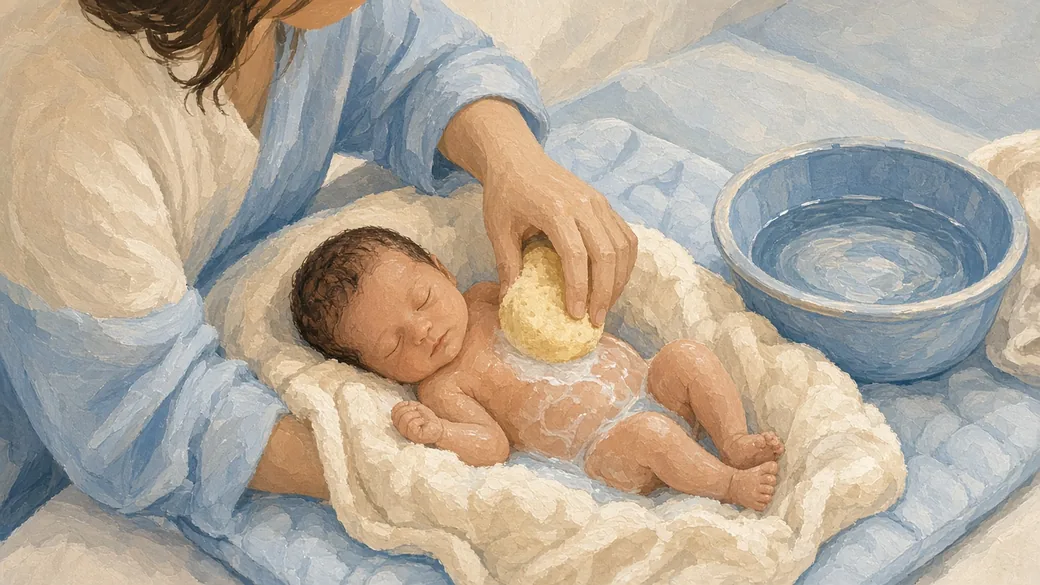
For a sponge bath, the AAP suggests a basin of water, a damp washcloth, a dry towel, and a flat padded surface. Keep one hand on the baby if they are above floor level. Wash the face first, then the body, then the diaper area, uncovering only the part you are washing so the baby stays warm. [1]
Once the umbilical area has healed, you can try a brief tub bath. Use a small amount of water—about 2 inches in the AAP description—support the head, and keep most of the body and face above the water while you pour water over the skin. Never leave a baby alone in the bath, even for a second; take the baby with you if you must leave the room. Both AAP and NHS advise against relying on bath seats: they can tip, and babies can drown quickly in very little water. Empty the bath when you finish. [1] [3]
Hospital timing of the very first bath is a separate topic: the AAP notes that the World Health Organization recommends delaying the first bath until 24 hours after birth when possible (or at least 6 hours if a full day is not possible). Ask your birth team what applies for your baby. [1]
What you can try
You can try sponge baths (or NHS-style topping and tailing) until the stump is gone and the area looks healed, instead of a full tub bath. [1] [3]
Many parents find it helps to fold the diaper below the stump and keep the area dry between washes, cleaning with warm water only when soiled. [2] [3]
Before undressing your baby, gather towel, clean diaper, clothes and a basin so you never need to step away mid-bath. [1] [3]
Check that the bath water feels warm—not hot—on your wrist or elbow, and mix well so there are no hot patches. Separately, you can set your water heater so the hottest faucet water is no more than 120°F (about 49°C), as the AAP recommends for home faucet safety—not as the bath temperature. [1] [3]
Keep one hand on your baby throughout, and skip bath seats; adult supervision is the safety plan. [1] [3]
When to call your pediatrician
Contact your pediatrician if you notice foul-smelling yellowish discharge from the cord, red skin around the base of the stump, or crying when you touch the cord or nearby skin. Call immediately for active bleeding from the cord. If the stump is still present after 3 weeks, the AAP says a doctor’s visit is needed. [2]
A newborn who has a fever, feeds poorly, or seems very unwell needs prompt medical advice—use Newborn: when to call the pediatrician and your local emergency numbers when signs are urgent. After bath time, put your baby on their back in a clear sleep space; see Safe sleep for babies. [4] [5]
Keep reading
 Health · 0–24 monthsRSV and bronchiolitis in babies: what health organizations saySymptoms, how long it lasts, care at home, US and UK protection options, and when to call, from the AAP, CDC, NHS and NICE.
 Health · 0–24 monthsHow can I help a baby with a cold or stuffy nose?Saline drops, suction, fluids, cough and cold medicine age limits in the US and UK, and when to call, from the AAP, FDA and NHS.
 Health · 0–12 monthsSpit-up and reflux: what's normalHow common spit-up is, when it eases, feeding tips, thickeners and medicines in the US and UK, safe sleep and when to call, from the AAP, NHS and NICE.
Join the BabyTides waitlist for updates about the app.
Join the waitlistSources
- American Academy of Pediatrics / HealthyChildren: Bathing Your Baby
- American Academy of Pediatrics / HealthyChildren: Umbilical Cord Care in Newborns
- NHS: Washing and bathing your baby
- NHS: When to get urgent medical help for babies and children under 5
- American Academy of Pediatrics / HealthyChildren: A Parent’s Guide to Safe Sleep
Sources checked November 15, 2026.