 BabyTides™
Join the waitlist
Sleep · 0–12 months
Safe sleep for babies: the basics every parent should know
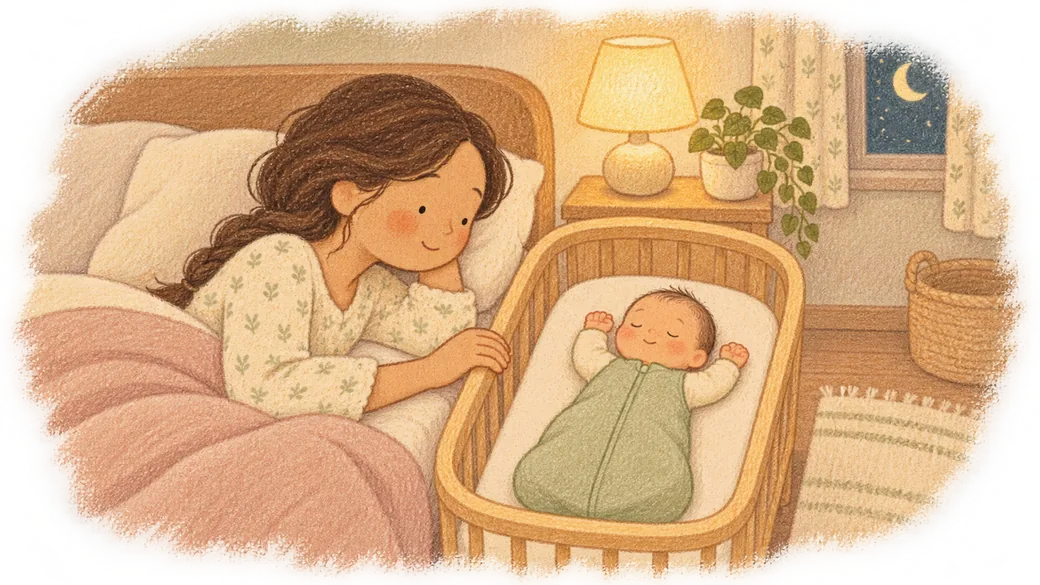
What the American Academy of Pediatrics (AAP), the CDC and the NHS say about where and how a baby should sleep: on the back, on a firm flat surface, in your room but not in your bed, and without pillows, blankets or soft toys. This article summarizes guidance from health organizations; it isn't personal medical advice.
Quick answers
How should a baby sleep?
The AAP says to place your baby on their back for every nap and every night, on a firm, flat surface with only a fitted sheet, in your room but not in your bed [1]. The NHS gives the same core advice [5].
Can my baby sleep in my bed?
The AAP recommends against bed sharing under any circumstances [1]. The NHS says a separate crib or bassinet is safest, and gives steps to make bed sharing less risky for parents who do it [5]. Both list situations where bed sharing is especially dangerous. Details are below.
How long should my baby sleep in my room?
The AAP and the NHS both say for at least the first 6 months [1, 5]. The CDC says ideally until about 6 months [3].
BabyTides app · coming to iPhone and Android
See your baby’s sleep, day by day
Log naps and nights in a tap. The weekly summary shows how much sleep there was and when, so changes are easier to see.

- Sleep log
- Notes
- Weekly summary
Want paper for now? Print our free newborn log, no sign-up needed.
Not in the App Store or Google Play yet. We’ll email you when it opens.
Why safe sleep matters
The AAP's 2022 policy statement says about 3,500 infants die of sleep-related causes in the US each year [2]. The CDC counts about 3,400 sudden unexpected infant deaths in 2024, including sudden infant death syndrome (SIDS), deaths from an unknown cause and accidental suffocation or strangulation in bed [4].
The AAP says its recommendations apply to babies up to 1 year old unless it says otherwise [1]. The NHS says that if your baby was born prematurely, you should follow its safer sleep advice for a year from their due date [5].
On the back, for every sleep
The AAP says to place babies on their back for all naps and at night, and that sleeping on the side is as dangerous as sleeping on the stomach [1]. The NHS says to place your baby on their back in the "feet to foot" position, with their feet touching the end of the crib [5].
Once babies can roll, the advice changes slightly. The AAP says that if your baby rolls both ways comfortably, you don't need to keep turning them onto their back [1]. The NHS says to roll your baby onto their back if they turn over, until they can roll back by themselves [5]. For when rolling usually starts, see rolling, sitting and crawling.
A firm, flat, empty sleep space
The AAP says to use a firm, flat surface: a crib, bassinet, portable crib or play yard that meets US Consumer Product Safety Commission (CPSC) standards, with a mattress made for it and only a fitted sheet [1]. It says any surface inclined more than 10 degrees isn't safe [1]. The CDC says not to use inclined surfaces [3].
The AAP says to keep these out of the sleep area [1]:
- pillows, quilts, comforters and blankets [1]
- mattress toppers and sheets that aren't fitted [1]
- stuffed toys [1]
- bumper pads [1]
The NHS also says not to use pods, nests or anything else meant to keep a baby in one position [5].
The AAP says to check CPSC recall lists, especially for older cribs, and not to use a crib with missing instructions or hardware or with broken parts [1].
Room sharing, not bed sharing
The AAP recommends sharing a room, but not a bed, with your baby for at least the first 6 months, with the baby's sleep space close to your bed [1]. It says room sharing can lower the risk of SIDS by as much as 50% [1]. The NHS says to put your baby in a separate crib or bassinet in the same room as you for every sleep for at least the first 6 months [5].
The AAP recommends against bed sharing under any circumstances, including with twins or other multiples [1]. It says that if you bring your baby into your bed to feed or comfort them, you should put them back in their own sleep space before you fall asleep [1]. If you think you might fall asleep with your baby in your bed, it says to remove pillows, blankets and anything else that could cover the baby's face, head or neck or make them overheat, and to move your baby to their own space if you wake up [1].
The NHS says a separate crib is safest, and that parents who share a bed should [5]:
- use a firm, flat mattress with the baby on their back [5]
- keep pillows, sheets and blankets away from the baby [5]
- not swaddle the baby, and use a baby sleeping bag instead [5]
- not have other children or pets in the bed [5]
- never leave the baby alone in an adult bed [5]
- make sure the baby can't fall out or get trapped between the mattress and the wall [5]
When bed sharing is especially dangerous
The AAP says bed sharing is especially risky if [1]:
- a parent has been drinking alcohol, has used marijuana or has taken medicines or drugs that make it harder to wake [1]
- a parent smokes or vapes, or the mother smoked during pregnancy [1]
- the baby is younger than 4 months, was born small or was born prematurely [1]
The NHS says not to share a bed if your baby was born before 37 weeks or weighed under 2.5 kg (5.5 lb) at birth, or if you or your partner smoke, have had 2 or more units of alcohol, have taken recreational drugs or have taken medicine that makes you drowsy [5].
Couches, armchairs, car seats and swings
The AAP says not to fall asleep with your baby on a couch, a soft armchair or cushions, and that the risk of a sleep-related death is up to 67 times higher in these places [1]. The NHS says never to sleep on a sofa or armchair with your baby [5].
The AAP says that if your baby falls asleep in a car seat, stroller, swing, carrier or sling, you should move them to a firm, flat surface on their back as soon as you can [1]. The NHS says babies can fall asleep in a car seat while you travel, but to take them out once you arrive [5].
For slings and carriers, the NHS says not to let fabric cover your baby's head, to take your baby out of the sling to feed, and to follow the T.I.C.K.S. rule: tight, in view at all times, close enough to kiss, keep the chin off the chest, and supported back [5].
Temperature, clothing and hats
The AAP says overheating raises the risk of SIDS [1]. It suggests dressing your baby in no more than one layer more than you would wear to be comfortable, using layers or a wearable blanket instead of loose blankets [1]. It lists sweating, a hot chest and flushed skin as signs your baby may be too warm [1].
The NHS suggests a room temperature of about 16 to 20°C (about 61 to 68°F), checked with a room thermometer [5]. It says to feel your baby's chest or the back of the neck to check how warm they are, since hands and feet are often cool, and to remove a layer if they feel hot or sweaty [5]. It says never to use a hot water bottle or electric blanket, or to put your baby to sleep next to a radiator, heater or fire or in direct sunlight [5].
The AAP says babies don't need a hat indoors after you come home from the hospital [1]. The NHS says to take off hats and extra layers when you come indoors or get into a warm car, bus or train, even if it wakes your baby [5].
The AAP says not to use weighted blankets, weighted sleepers, weighted swaddles or other weighted objects on or near a sleeping baby [1].
Swaddling and when to stop
The AAP says swaddling doesn't lower the risk of SIDS [1]. If you swaddle, it says to always place your baby on their back, not to wrap too tightly, and to leave room for breathing and for the hips to move [1]. It says to stop swaddling when your baby shows signs of trying to roll over, which it says usually starts around 3 to 4 months but can happen earlier [1].
The NHS says not to swaddle a baby who is sharing your bed, and to use a baby sleeping bag instead [5].
Pacifiers
The AAP says to offer a pacifier at naps and bedtime, and that it lowers the risk of SIDS even if it falls out once your baby is asleep [1]. For breastfed babies, it suggests waiting until breastfeeding is going well [1]. It says not to hang a pacifier around your baby's neck or clip it to their clothes during sleep [1]. The NHS says to consider a pacifier when settling your baby, because some research suggests it may lower the risk of SIDS [5].
The AAP also says breast milk lowers the risk of SIDS, and that the protection is greater the longer a baby is breastfed [1]. The CDC says to feed your baby breast milk when possible [3].
Colds, reflux and raising the crib
A stuffy nose or reflux can make parents want to prop their baby up. The AAP says any sleep surface inclined more than 10 degrees isn't safe [1]. For reflux, it says raising the head of the crib doesn't reduce reflux and isn't safe, because a baby may roll toward the foot of the crib or into a position that causes serious breathing problems [6]. It says back sleeping is still recommended for babies with reflux, and that the gag reflex protects babies from choking on their backs [6].
For what may help a stuffy nose, see colds and stuffy noses. For reflux, see spit-up and reflux.
Products and monitors
The AAP says to avoid products that claim to lower the risk of SIDS or sleep-related death, because there's no evidence that they work [1]. It says products that aren't made for infant sleep, such as nursing pillows and loungers, shouldn't be used for sleep [1].
The AAP says home heart and breathing monitors and consumer devices that track heart rate or oxygen levels shouldn't be used to prevent SIDS, and don't replace safe sleep practices [1].
Smoke, alcohol and drugs
The AAP says not to smoke or vape during pregnancy or after your baby is born, and to keep your home and car smoke-free, because exposure to nicotine raises the risk of SIDS [1]. It says to avoid alcohol, marijuana, opioids and illegal drugs during pregnancy and after birth [1]. The NHS says not to let anyone smoke in the room where your baby sleeps [5].
The CDC and the NHS both say to keep up with your baby's well-child visits and routine vaccinations [3, 5]. The NHS says vaccinations protect against illnesses that may raise the risk of SIDS [5].
Awake time on the tummy
Back is for sleep. While your baby is awake and someone is watching, the AAP recommends tummy time starting soon after you come home, building up to 15 to 30 minutes a day by 7 weeks [1]. It says tummy time supports motor development and helps prevent a flat spot on the back of the head [1]. See tummy time for how to start.
Where US and UK advice differ
| Topic | AAP (US) | NHS (UK) |
|---|---|---|
| Bed sharing | Recommends against it under any circumstances [1]. | Says a separate crib is safest, and gives steps to make bed sharing less risky, plus situations when not to do it [5]. |
| Room temperature | Its safe sleep page gives no number; it says to watch for signs of overheating [1]. | About 16 to 20°C (about 61 to 68°F) [5]. |
| Covers | No blankets; layers or a wearable blanket [1]. | Lightweight blankets, sheets or a baby sleeping bag, with the baby feet to foot [5]. |
Both say: on the back for every sleep, a firm flat mattress, no pillows, bumpers or soft toys, your room for at least 6 months, and never asleep with your baby on a sofa or armchair [1, 5].
Keep reading
 Sleep · 3–6 monthsThe 4-month sleep regression: what's really changingHow baby sleep matures around 4 months, what the evidence does and doesn't show, and what may help.
 Sleep · 0–12 monthsWhen do babies start sleeping through the night?What sleeping through really means, what research shows in the first year, and what may help longer stretches.
 Sleep · 0–24 monthsWhy does my baby wake up so often at night?The usual reasons babies wake, from hunger to separation anxiety, what may help, and when to call your pediatrician.
BabyTides is coming to iPhone and Android. Join the waitlist and we'll email you when it opens.
Join the waitlistSources
- American Academy of Pediatrics, HealthyChildren.org. How to Keep Your Sleeping Baby Safe: AAP Policy Explained. Updated September 11, 2026.
- Moon RY, Carlin RF, Hand I; Task Force on Sudden Infant Death Syndrome and the Committee on Fetus and Newborn. Sleep-related infant deaths: updated 2022 recommendations for reducing infant deaths in the sleep environment. Pediatrics. 2022;150(1):e2022057990. doi:10.1542/peds.2022-057990.
- Centers for Disease Control and Prevention. Providing Care for Babies to Sleep Safely. Updated September 17, 2024.
- Centers for Disease Control and Prevention. Data and Statistics for SUID and SIDS. Updated August 13, 2026.
- NHS. Sudden infant death syndrome (SIDS). Reviewed November 25, 2025.
- American Academy of Pediatrics, HealthyChildren.org. What is the safest sleep solution for my baby with reflux? Updated November 30, 2021.
Sources checked November 2, 2026.