 BabyTides™
Join the waitlist
Crying · 0–5 months
Colic: what it is and what helps
Colic is the name doctors give to long, hard-to-soothe crying in a young baby who is otherwise healthy. Here's how it's defined, what's known about why it happens, what research says about the remedies parents often try, and when to call.

What doctors mean by colic
The NHS describes colic as a baby crying a lot when there's no obvious cause [1]. The classic definition is the "rule of threes," which goes back to a 1954 study by Wessel and colleagues: unexplained bouts of crying for more than 3 hours a day, on 3 or more days a week, for at least 3 weeks [2]. The NHS uses a shorter version: more than 3 hours a day, 3 days a week, for at least 1 week, in a baby who is otherwise healthy [1].
The 2016 expert criteria known as Rome IV added separate colic criteria for pediatricians and for researchers [3]. As a 2022 Cochrane protocol summarizes them, Rome IV drops the 3-hour minimum as too arbitrary. It describes a baby younger than 5 months when symptoms start and stop, with long, repeated spells of crying or fussing that have no obvious cause and that parents can't prevent or stop, and no sign of poor growth, fever or illness [2].
Both the NHS and Rome IV definitions describe a baby who is otherwise well [1, 2]. The AAP's first step is to see your pediatrician, to make sure the crying isn't related to a serious medical problem [4]. The NHS notes that crying can also come from hunger, a dirty diaper, gas, reflux or constipation [1]. Our guide to why babies cry covers these everyday reasons to check.
BabyTides app · coming to iPhone and Android
Know when they last slept and fed
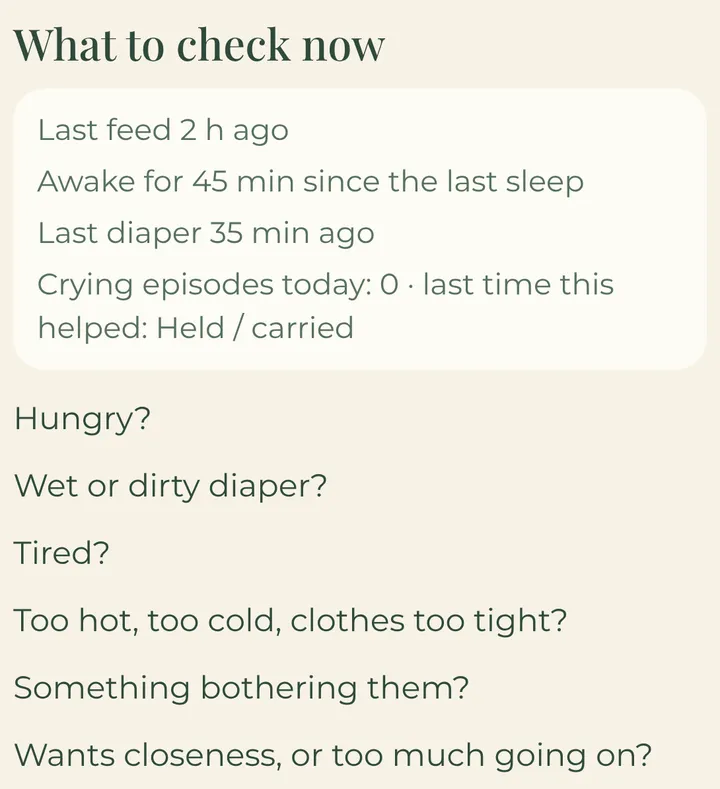
Log sleep, feeds and diapers in a tap. When the crying starts, BabyTides shows what to check first, from your own log.

- Sleep and feeds
- What to check
- Weekly summary
Want paper for now? Print our free newborn log, no sign-up needed.
Not in the App Store or Google Play yet. We’ll email you when it opens.
How common it is and how long it lasts
The AAP says about one baby in five develops colic, usually between the second and fourth weeks [4]. Estimates depend a lot on the definition: the Cochrane protocol gives a range of 4% to 28% of babies [2].
Colic passes. The NHS says it usually stops by 3 to 4 months [1]. The AAP gives the same age, adding that it can last until 6 months [4]. The Cochrane protocol describes colic as the upper end of the normal crying curve, and notes that because it usually settles by itself, offering no treatment is a reasonable option [2].
The NHS says colicky crying is often more frequent in the afternoon and evening, and a baby may clench their fists, go red in the face, draw their knees up or arch their back [1]. Our article on why babies cry in the evening looks at those hours.
What causes it
No one knows for sure. The AAP says there is no definite explanation [4]. Most often, it says, a baby with colic is simply unusually sensitive to stimulation. Sometimes, in breastfed babies, colic may be a sign of sensitivity to a food in the parent's diet, and colicky behavior may also signal a medical problem such as a hernia or an illness [4]. The NHS mentions two possibilities: young babies may find digestion harder, or a food allergy, such as cows' milk allergy, may be involved [1].
The Cochrane protocol lists other ideas researchers have studied, such as gut bacteria and extra gas, and calls the cause unclear and likely to involve several factors [2].
What research says about common remedies
Cochrane reviews, which pool the results of trials, have looked at several remedies parents often hear about. The AAP's first step, before any of them, is a visit to your pediatrician [4].
Probiotics. A 2019 Cochrane review of 6 trials with 1,886 babies looked at giving probiotics to prevent colic. It found they made little or no difference to whether babies developed colic [5]. Daily crying time was about 33 minutes lower with probiotics, and there was no clear difference in serious side effects, but the reviewers rated the evidence for each of these findings as low certainty [5]. For treating colic once it has started, Cochrane has so far published only a protocol, not a finished review; it notes that a separate earlier review highlighted one strain, Lactobacillus reuteri DSM 17938, for reducing crying time [2]. The NHS doesn't recommend probiotic supplements for colic and says there's no evidence they help [1].
Simethicone and other pain-relieving remedies. A 2016 Cochrane review of 18 trials with 1,014 babies looked at simethicone, herbal remedies, sugar solutions and two antispasmodic medicines [6]. It found no evidence to support simethicone. For herbal remedies, low-quality evidence suggested less crying and moderate-quality evidence suggested more babies responded, though the size of the benefit varied a lot from study to study [6]. Even so, the reviewers concluded that herbal remedies, sugar and the two antispasmodics can't be recommended for babies with colic; one antispasmodic was the only remedy linked to serious side effects, and some of its studies reported problems such as drowsiness [6]. They called the evidence sparse and prone to bias, from a few small studies, most with serious limitations [6]. The NHS says anti-colic drops and herbal supplements aren't recommended, because there's no evidence they help [1].
Chiropractic and osteopathy. A 2012 Cochrane review of 6 studies with 325 babies found about an hour less crying a day overall with chiropractic, osteopathy and cranial manipulation. In the studies where parents didn't know which treatment their baby had, the difference was not statistically significant [7]. The studies were small and prone to bias, so no firm conclusion was possible, and there were too few data to judge safety [7]. The NHS doesn't recommend spinal manipulation or cranial osteopathy: it says the evidence that they help is thin and that they could hurt your baby [1].
Changing formula or diet. A 2018 Cochrane review of 15 trials with 1,121 babies looked at special formulas (hydrolyzed, partially hydrolyzed and soy), a low-allergen diet for breastfeeding mothers, lactase and an herbal extract. A few small studies reported benefits, and results for hydrolyzed formulas were inconsistent. The reviewers rated the evidence as very low quality and were unable to recommend any of these changes [8].
Here the AAP and NHS differ. The NHS says you can keep feeding as usual and breastfeeding mothers don't need to change their diet [1]. The AAP says a nursing parent may try cutting out possible trigger foods, such as milk products or caffeine, and that this is worth discussing with your pediatrician first; it suggests removing one food at a time and allowing about 2 weeks to see a change [4]. For a formula-fed baby, it suggests talking with your pediatrician about a protein hydrolysate formula [4]. It also notes that food sensitivity causes less than 5% of colicky crying [4]. Either way, the AAP's advice is to talk with your pediatrician before changing your diet or your baby's formula [4].
Soothing and coping
The NHS suggests holding or cuddling your baby, keeping them upright during feeds and burping them afterward, gentle rocking, a warm bath or gentle white noise [1]. The AAP adds a walk in a baby carrier, a pacifier, and laying your baby tummy-down across your knees while gently rubbing their back; if they fall asleep that way, it says to put them in the crib on their back [4].
When you feel tense, the AAP suggests letting another adult take over while you take a break, even for an hour or two [4]. If no one can, the AAP and NHS say it's OK to put your baby on their back in the crib or another safe place and leave the room for a few minutes; the NHS suggests a time limit, such as 10 minutes [4, 9]. Never shake a baby, however frustrated you feel [4, 9]. Shaking can cause blindness, brain damage or death [4].
In the UK, the NHS lists the Cry-sis helpline, 0800 448 0737, open 9am to 10pm every day [9]. If you feel depressed or are struggling with your emotions, the AAP suggests telling your own doctor [4].
When to call
The NHS says to trust your instincts if you think something is seriously wrong, especially if your baby has other worrying symptoms [1].
Call your pediatrician (in the UK, NHS 111 or your GP) if:
- you're worried about your baby's crying, or finding it hard to cope [1]
- nothing you try seems to help your baby's colic [1]
- your baby isn't growing or gaining weight as expected [1]
- your baby still has colic symptoms after 4 months [1]
- your baby seems unwell, for example has a high temperature or isn't interested in feeding [9]
- your baby is younger than 3 months (12 weeks) and has a temperature of 100.4°F (38.0°C) or higher. The AAP says to call right away [10].
Call 911 (in the UK, 999 or go to A&E) or your local emergency number if your baby:
- has a weak or high-pitched cry, or a cry that doesn't sound like their normal cry [1]
- has a seizure (fit) [9]
- has blue, gray, pale or blotchy skin, lips or tongue (on brown or black skin, check the palms and soles, where this can be easier to see) [9]
- is unresponsive, floppy or harder to wake than usual [9]
- has trouble breathing (you may hear grunting or see their stomach sucking in under the ribs) [9]
- is breathless or breathing very fast [9]
- is vomiting forcefully and often (projectile vomiting) [9]
- has a high or low temperature [9]
- has a rash that doesn't fade when pressed [9]
- hasn't had a wet diaper in the past 8 hours [9]
Writing it down helps
The NHS suggests keeping a record of how often and when your baby cries, which can help your health visitor or GP spot a pattern or a possible cause [9].
BabyTides is being built to help. You'll be able to log feeds, sleep and diapers in a tap, and when your baby is crying, open a calm checklist of common reasons to check, with your recent log next to it and AAP and NHS guidance on when to call. It can't tell you why your baby is crying, or whether it's colic.
Keep reading
 Crying · 0–4 monthsWhy does my baby cry every evening?What's typical, what doctors mean by colic, what may help, and when to call your pediatrician.
 Crying · 0–24 monthsAre the Wonder Weeks real? What the research saysWhere the fussy-week calendar comes from, what later studies found, and what the AAP and NHS say.
 Crying · 0–4 monthsCrying in the first weeks: the normal crying curveHow much young babies cry, what studies found about the 6-week peak, and when crying is a reason to call.
BabyTides is coming to iPhone and Android. Join the waitlist and we'll email you when it opens.
Join the waitlistSources
- NHS. Colic. Reviewed April 26, 2022.
- Grafton-Clarke C, Gordon M, Sinopoulou V, Wallace C. Oral probiotics for the treatment of infantile colic (protocol). Cochrane Database of Systematic Reviews. 2022;(5):CD015262. doi:10.1002/14651858.CD015262.
- Benninga MA, Faure C, Hyman PE, St James Roberts I, Schechter NL, Nurko S. Childhood functional gastrointestinal disorders: neonate/toddler. Gastroenterology. 2016.
- American Academy of Pediatrics, HealthyChildren.org. Colic Relief Tips for Parents. Updated April 22, 2024.
- Ong TG, Gordon M, Banks SSC, Thomas MR, Akobeng AK. Probiotics to prevent infantile colic. Cochrane Database of Systematic Reviews. 2019;(3):CD012473.
- Biagioli E, Tarasco V, Lingua C, Moja L, Savino F. Pain-relieving agents for infantile colic. Cochrane Database of Systematic Reviews. 2016;(9):CD009999.
- Dobson D, Lucassen PLBJ, Miller JJ, Vlieger AM, Prescott P, Lewith G. Manipulative therapies for infantile colic. Cochrane Database of Systematic Reviews. 2012;(12):CD004796.
- Gordon M, Biagioli E, Sorrenti M, Lingua C, Moja L, Banks SSC, Ceratto S, Savino F. Dietary modifications for infantile colic. Cochrane Database of Systematic Reviews. 2018;(10):CD011029.
- NHS. Soothing a crying baby. Reviewed April 22, 2026.
- American Academy of Pediatrics, HealthyChildren.org. Fever: When to Call the Pediatrician. Updated December 2, 2022.
Sources checked October 27, 2026.