 BabyTides™
Join the waitlist
Crying · 0–4 months
Why does my baby cry every evening?
Many babies have a long, hard-to-settle stretch in the late afternoon or evening during the first months. Here's what's typical, what doctors mean by colic, what may help, and when to call your pediatrician.

Quick answers
Why is my baby fussy in the evening?
Many young babies have a regular fussy period, often between 6 p.m. and midnight, and crying spells often get worse in the early evening [1]. No one knows exactly why. One idea is that some babies are especially sensitive to stimulation and can't yet calm themselves down [1].
Is evening crying the same as colic?
Not always. Doctors call it colic when an otherwise healthy baby cries for more than 3 hours a day, 3 days a week, for at least a week [2], and only once a doctor has checked that nothing else is going on [1]. About one baby in five develops colic [1].
When does it stop?
The AAP says daily fussing usually peaks at about 3 hours a day around 6 weeks and drops to 1 or 2 hours a day by 3 to 4 months [1]. Colic usually ends by 3 to 4 months, though it can last until 6 months [1].
BabyTides app · coming to iPhone and Android
Know when they last slept and fed
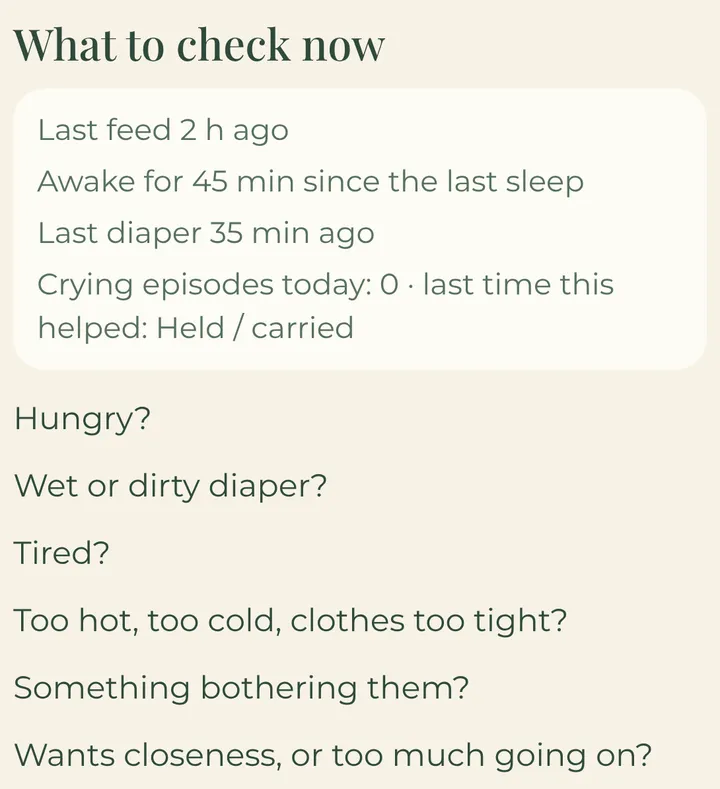
Log sleep, feeds and diapers in a tap. When the crying starts, BabyTides shows what to check first, from your own log.

- Sleep and feeds
- What to check
- Weekly summary
Want paper for now? Print our free newborn log, no sign-up needed.
Not in the App Store or Google Play yet. We’ll email you when it opens.
Evening crying is very common
If your baby is calm for most of the day and then cries for hours in the evening, you're far from alone. Pediatricians describe regular fussy periods as common in young babies, often somewhere between 6 p.m. and midnight [1].
Crying usually builds from around 2 weeks, peaks at about 6 weeks, and eases by 3 to 4 months [1]. A review of studies from several countries found that babies fuss and cry for about two hours a day on average in their first 6 weeks, and for about an hour a day by 10 to 12 weeks [3]. Those are averages: some babies cry much less, some much more.
What doctors mean by colic
Colic is the word doctors use when an otherwise healthy baby cries a lot and there's no clear cause. A common rule of thumb is crying for more than 3 hours a day, on more than 3 days a week, for at least a week [2]. It affects roughly one baby in five [1].
Colicky crying often comes with a red face, clenched fists, knees pulled up to the tummy or an arched back, and it can be very hard to soothe [2]. No one knows exactly why it happens. One idea is that some babies are especially sensitive to stimulation and can't yet calm themselves down [1]. What it isn't: a sign that you're doing something wrong.
Colic can only be called colic once a doctor has checked that nothing else is going on, so it's worth mentioning long crying spells at your baby's next visit, or sooner if anything on the list below applies [1].
For more on colic, including what usually helps and what doesn't, read Colic: what it is and what helps.
Things that may help
Nothing works for every baby, and what works one evening may not work the next. It's fine to try one thing at a time.
- Hold and cuddle. Being held close is often the most calming thing for a young baby [2].
- Feed upright and burp afterward. Holding your baby fairly upright during feeds and burping them after can help with swallowed air [2].
- Gentle, steady motion. Rocking, walking with your baby in a carrier, or a ride in the stroller [1, 2].
- Steady background sound. A fan, a white-noise machine or quiet radio [1, 2]. Never put your baby on top of a washer or dryer [1].
- A warm bath can relax some babies [2].
- A pacifier, if your baby takes one [1].
- Swaddling in a thin blanket can calm some babies [1]. Keep the hips loose, avoid overheating, always place your baby on their back to sleep, and stop swaddling as soon as your baby shows signs of trying to roll [4].
Keep feeding as usual. Breastfeeding parents usually don't need to change their diet [2]. In some babies a food sensitivity plays a part, so if you're thinking about cutting foods from your own diet or switching formula, talk it through with your pediatrician first [1]. It also helps not to feed too often: your pediatrician can tell you what spacing suits your baby [1].
What probably won't help
Anti-colic drops, herbal remedies and probiotics are widely sold, but the UK's National Health Service doesn't recommend them because there's no good evidence that they help colic [2]. Spinal manipulation and cranial osteopathy also lack evidence and could hurt your baby [2]. Always check with your pediatrician before giving your baby any medicine or supplement.
Look after yourself, too
Hours of crying are exhausting, and feeling frustrated doesn't make you a bad parent. If you can, hand your baby to another adult and get out of the house for an hour [1]. If you're on your own and feel overwhelmed, it's okay to put your baby on their back in the crib or another safe place and leave the room for a few minutes to calm down [1].
Never shake a baby. Shaking can cause blindness, brain damage or death [1]. If you feel low, anxious or unable to cope, tell your doctor. That's part of their job, and help is available [1, 2].
When to call the doctor
Get help right away if your baby:
- has a weak or high-pitched cry, or a cry that doesn't sound like their usual cry [2]
- is younger than 3 months and has a temperature of 100.4°F (38.0°C) or higher [5]
- seems very sleepy, very irritable or seriously ill, has trouble breathing, or vomits repeatedly [5]
Call your pediatrician for a non-urgent visit if you're worried about the crying, if nothing seems to help, if your baby isn't feeding well or gaining weight, if the crying continues past 4 months, or if you're finding it hard to cope [2].
Writing it down helps
When you talk to your pediatrician, a short record of when your baby cried, fed and slept over a few days is more useful than a memory of one hard night. That's what BabyTides will help with: a one-handed log of feeds, sleep and fussy spells you can show your doctor. It won't tell you why your baby is crying, because no app can know that for sure.
Wondering how much sleep is typical at your baby's age? See our guide to baby sleep by age.
For an overview of baby crying, with links to all our guides on it, see Baby crying: what's normal, what helps and when to call.
Keep reading
 Crying · 0–24 monthsAre the Wonder Weeks real? What the research saysWhere the fussy-week calendar comes from, what later studies found, and what the AAP and NHS say.
 Crying · 0–4 monthsCrying in the first weeks: the normal crying curveHow much young babies cry, what studies found about the 6-week peak, and when crying is a reason to call.
 Crying · 0–5 monthsColic: what it is and what helpsWhat doctors mean by colic, what reviews of the research say about common remedies, and when to call.
BabyTides is coming to iPhone and Android. Join the waitlist and we'll email you when it opens.
Join the waitlistSources
- American Academy of Pediatrics, HealthyChildren.org. Colic. Updated April 22, 2024.
- NHS. Colic. Reviewed April 26, 2022.
- Wolke D, Bilgin A, Samara M. Systematic review and meta-analysis: fussing and crying durations and prevalence of colic in infants. Journal of Pediatrics. 2017;185:55–61.
- American Academy of Pediatrics, HealthyChildren.org. Swaddling: Is it Safe? Updated July 15, 2022.
- American Academy of Pediatrics, HealthyChildren.org. Fever: When to Call the Pediatrician. Updated December 2, 2022.
Sources checked October 14, 2026. Sources 1 and 2 rechecked October 27, 2026.