 BabyTides™
Join the waitlist
Crying · 0–12 months
Why is my baby crying? Common reasons and what helps
Crying is the main way a baby can tell you something, and working out what it means takes time. Here are the common reasons the AAP and NHS describe, the soothing ideas they suggest, and the signs that mean it's time to call.

Crying is how babies communicate
The NHS describes crying as your baby's way of communicating, and notes that a baby isn't crying to punish you [4]. Sometimes the reason is easy to spot, and sometimes it isn't [1].
The AAP says it's routine for newborns to cry for 1 to 4 hours a day, and that as you get to know your baby's crying patterns, you may feel you can recognize some of their needs from the cry [2].
The AAP recommends responding promptly in the first few months. It says attention won't spoil a young baby, and that babies whose calls for help are answered tend to cry less overall [2].
BabyTides app · coming to iPhone and Android
Know when they last slept and fed
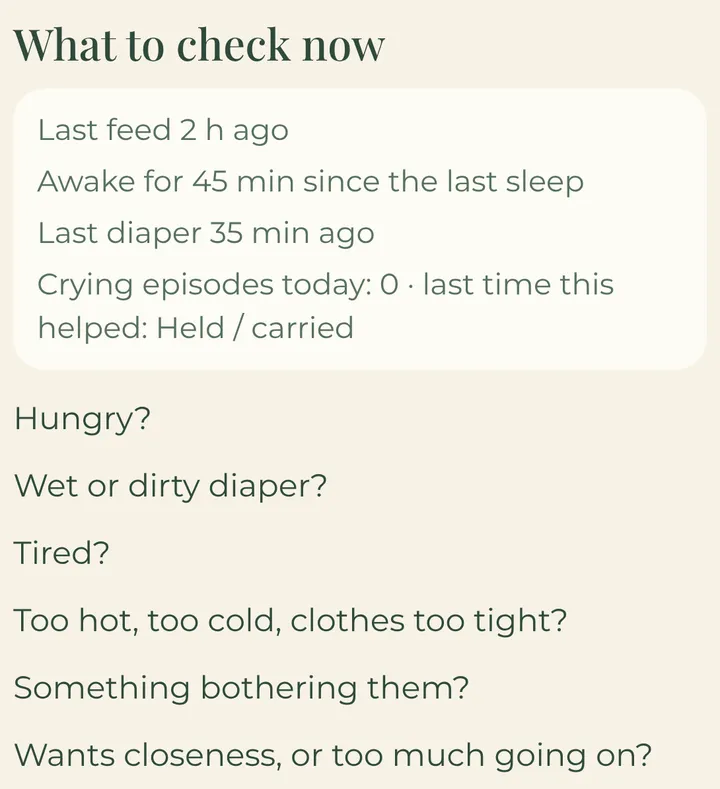
Log sleep, feeds and diapers in a tap. When the crying starts, BabyTides shows what to check first, from your own log.

- Sleep and feeds
- What to check
- Weekly summary
Want paper for now? Print our free newborn log, no sign-up needed.
Not in the App Store or Google Play yet. We’ll email you when it opens.
Common reasons to check
The AAP and NHS name much the same everyday causes [1, 2, 3, 4].
- Hunger. The NHS lists it among the most common reasons [1], and both AAP pages mention it [2, 3]. The AAP suggests keeping track of feeding times and watching for early signs of hunger, such as lip-smacking or moving their fists to their mouth [3].
- Tiredness. The NHS lists it among the most common causes [1].
- A wet or dirty diaper. Newborns go through a lot of them [3].
- Too hot or too cold. The NHS lists this as a common reason [1], and the AAP suggests dressing your baby in about the same number of layers you're wearing [3].
- Wind. The NHS lists wind as a common reason [1], and the AAP includes burping among things to try [2]. If your baby spits up or vomits a lot, the AAP notes this may be a sign of reflux, and that the fussiness can be mistaken for colic [3]. The NHS says crying during feeds can sometimes be a sign of reflux and suggests talking to your health visitor or GP [1].
- Wanting to be held. Sometimes a baby simply wants a cuddle [1].
- Too much going on. Crying can be a baby's way of shutting out sights, sounds and other sensations that have become too much [2]. The NHS lists signs a baby needs a break, such as yawning, turning away or closing their eyes, and suggests moving somewhere quieter [4].
- Other discomfort. The AAP notes that a shrieking or panicked cry may mean something is making your baby uncomfortable, such as a piece of clothing or a hair wrapped around a finger or toe [2].
- Illness. Crying that you can't soothe, or a cry that doesn't sound like your baby's usual cry, may be a sign your baby is unwell [1, 2]. The signs to watch for are in the section on when to call.
Ways to soothe your baby
Once your baby is fed, dry and warm, the AAP and NHS suggest a range of things to try [1, 2, 3, 4].
- Closeness. Holding or carrying your baby close, swaying, or holding them skin to skin [1, 4].
- Gentle touch. Stroking their head, or gently stroking, rubbing or patting their back [1, 2, 3, 4].
- Movement. Rocking, walking with your baby, or a ride in the stroller or car [1, 2]. If your baby falls asleep in a car seat, the NHS advises taking them out as soon as you can and moving them to a firm, flat surface to sleep [1].
- Steady sound. Singing, humming, soft music, or background sound such as white noise or a fan [1, 2, 3, 4].
- Sucking. Breastfeeding, or a pacifier if it isn't time for a feed [1, 3, 4]. The NHS says a pacifier can be offered after 4 weeks for breastfed babies, or at any time for formula-fed babies [4].
- A warm bath. It calms some babies, but not all of them enjoy it [1, 2, 4].
If your baby falls asleep while you're soothing them, the AAP says to lay them down on their back in their crib [3].
When you can't find a reason
You can check every item on the list and your baby may still cry. The AAP says all babies cry, often for no clear reason [2]. It describes fussy spells that happen even when a baby isn't hungry, uncomfortable or tired, and says this crying seems to help babies let off excess energy [2]. The NHS also notes that a baby may still cry after you've checked the basics, and lists comfort ideas for that moment [4].
If your baby doesn't seem ill and nothing has worked, the AAP says the best approach may be to leave them in a safe place such as their crib. Many babies fall asleep sooner if left to cry, it says, and the crying shouldn't last long if your baby is truly tired [2]. No parent can soothe their baby every time, the AAP adds [2].
The NHS says excessive crying could be a sign of colic, which sometimes happens in babies under 5 months, and that the crying can go on for some hours [1]. Our guide to why babies cry in the evening covers colic and evening fussiness in more detail. If you've been told your baby's crying follows a schedule of fussy weeks, see what the research says about the Wonder Weeks.
If you feel overwhelmed
Feeling upset, frustrated or even angry when your baby keeps crying is normal, the AAP says [3]. If you need a break, the AAP suggests setting your baby down somewhere safe and asking a family member or friend to take over [2, 5].
If no one is around, the AAP and NHS say you can lay your baby on their back in a safe place, such as a crib with no blankets or soft toys, and leave the room for a short break [1, 3, 4, 5]. The NHS suggests setting a time limit, for example 10 minutes, and the AAP mentions about 10 to 15 minutes [1, 3]. The AAP suggests checking on your baby without picking them up until you feel calm, then trying to soothe them again [3]. The NHS suggests talking to a friend, your health visitor or your doctor [1, 4]. In the UK, the NHS lists the free Cry-sis helpline, 0800 448 0737, open 9am to 10pm every day [1, 4].
Never shake a baby, however frustrated you feel [1, 2, 4]. Shaking can cause brain damage, blindness or death [1, 2, 5].
When to call your pediatrician
The NHS says to trust your instincts, because you know what's unusual or worrying for your baby [1].
Call your pediatrician (in the UK, your GP or NHS 111) if your baby is crying and:
- seems unwell, for example has a high temperature or doesn't want to feed [1]
- can't be soothed and has a rectal temperature of 100.4°F (38°C) or higher [2]
- is younger than 3 months (12 weeks) and has a temperature of 100.4°F (38.0°C) or higher. The AAP says to call right away [6].
- is fussy after feeds, spits up or vomits a lot, or is losing weight or not gaining it [3]
Call 911 (999 in the UK) or your local emergency number if your baby:
- has a seizure [1]
- has blue, gray, pale or blotchy skin, lips or tongue (on brown or black skin, check the palms and soles, where this can be easier to see) [1]
- is unresponsive, floppy or harder to wake than usual [1]
- has trouble breathing, is breathless or is breathing very fast [1]
- is vomiting forcefully and often (projectile vomiting) [1]
- has a high or low temperature [1]
- has a rash that doesn't fade when pressed [1]
- hasn't had a wet diaper in the past 8 hours [1]
Writing it down helps
The NHS suggests noting when your baby cries and how often. It says this can help your health visitor or GP see whether there's a particular cause, and help you spot the times you need extra support [1]. The AAP also suggests a diary of waking, sleeping, eating and crying, to talk over with your doctor and see whether the crying is linked to sleep or feeding [3].
BabyTides is being built to make part of that easier. You'll be able to log feeds, sleep and diapers in a tap, and when your baby is crying, open a calm checklist of common reasons to check, with your recent log next to it and AAP and NHS guidance on when to call. It can't tell you why your baby is crying.
For an overview of baby crying, with links to all our guides on it, see Baby crying: what's normal, what helps and when to call.
Keep reading
 Crying · 0–4 monthsWhy does my baby cry every evening?What's typical, what doctors mean by colic, what may help, and when to call your pediatrician.
 Crying · 0–24 monthsAre the Wonder Weeks real? What the research saysWhere the fussy-week calendar comes from, what later studies found, and what the AAP and NHS say.
 Crying · 0–4 monthsCrying in the first weeks: the normal crying curveHow much young babies cry, what studies found about the 6-week peak, and when crying is a reason to call.
BabyTides is coming to iPhone and Android. Join the waitlist and we'll email you when it opens.
Join the waitlistSources
- NHS. Soothing a crying baby. Reviewed April 22, 2026.
- American Academy of Pediatrics, HealthyChildren.org. Responding to Your Baby's Cries. Updated February 20, 2025.
- American Academy of Pediatrics, HealthyChildren.org. How to Calm a Fussy Baby: Tips for Parents & Caregivers. Updated March 21, 2022.
- NHS Best Start in Life. Understanding your baby. Updated December 23, 2025.
- American Academy of Pediatrics, HealthyChildren.org. Colic. Updated April 22, 2024.
- American Academy of Pediatrics, HealthyChildren.org. Fever: When to Call the Pediatrician. Updated December 2, 2022.
Sources checked October 27, 2026.