 BabyTides™
Join the waitlist
Crying · 0–4 months
Crying in the first weeks: the normal crying curve
Crying usually builds over the first weeks of life and then eases. Here's what research and health guidance say about how much young babies cry, when in the day it tends to happen, and how much the pattern varies from baby to baby.
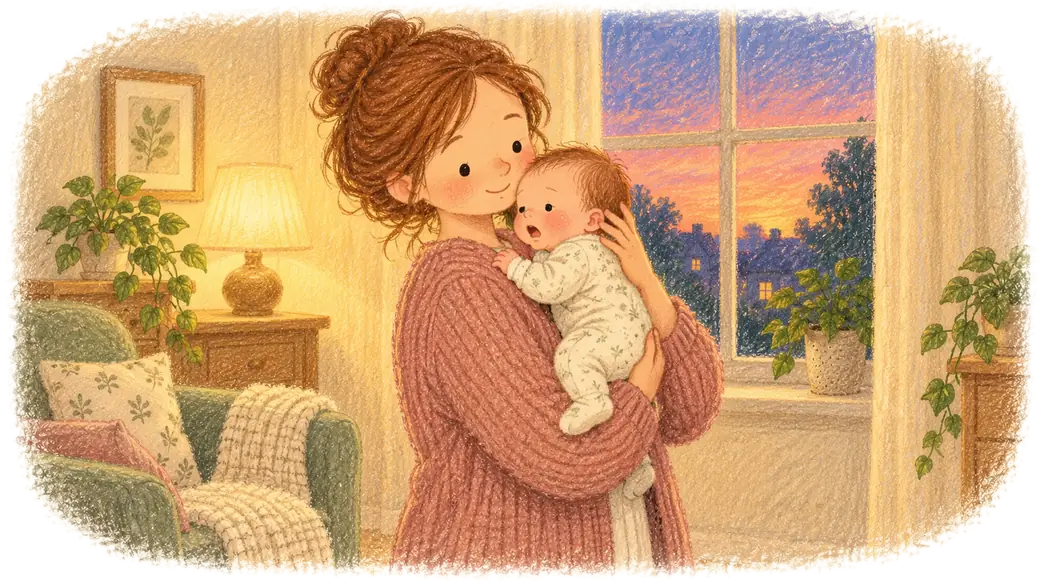
When does newborn crying peak?
Crying often increases in the first weeks and eases over the following months. You may hear that it peaks at 6 weeks, but studies do not show one fixed peak for every baby [1–4]. The pattern varies: read the research below, explore what may help with evening crying, or go straight to when to call your doctor if you are worried.
BabyTides app · coming to iPhone and Android
Know when they last slept and fed
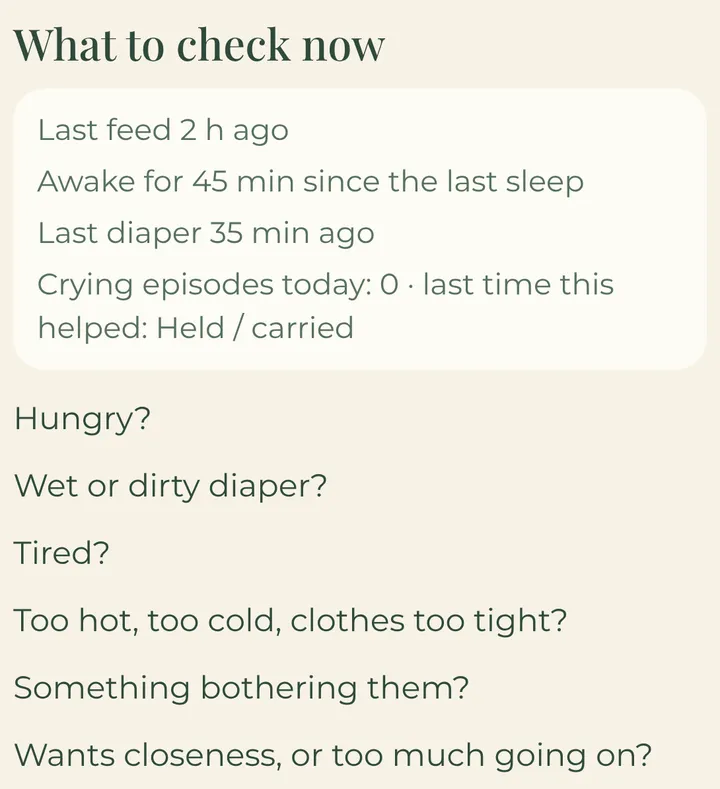
Log sleep, feeds and diapers in a tap. When the crying starts, BabyTides shows what to check first, from your own log.

- Sleep and feeds
- What to check
- Weekly summary
Want paper for now? Print our free newborn log, no sign-up needed.
Not in the App Store or Google Play yet. We’ll email you when it opens.
How much young babies cry
All babies cry, and some cry more than others, the NHS says [1]. The amount of crying usually goes up from about 2 weeks old and slowly lessens at around 3 months [1]. The American Academy of Pediatrics (AAP) describes a similar shape: regular fussing usually reaches a peak of about 3 hours a day by 6 weeks of age, then declines to 1 to 2 hours daily by age 3 to 4 months [2].
Researchers call this rise and fall the normal crying curve; the 2017 review described below traces the pattern to earlier studies, including work by T. Berry Brazelton and Ronald Barr [3].
The biggest pooled estimate for the first 3 months comes from a 2017 review of 28 studies covering 8,690 babies, in which parents kept 24-hour diaries of their baby's behavior [3]. On average, babies fussed and cried for about 117 to 133 minutes a day (roughly 2 hours) in their first 6 weeks, and about 68 minutes a day at 10 to 12 weeks, with the drop becoming clear after 8 to 9 weeks [3]. Individual babies varied widely around these averages: in the first 6 weeks, the standard deviation was about 66 to 70 minutes a day [3].
A 2022 review pooled parent-reported data, from diaries and questionnaires, across 57 studies in 17 countries and the whole first year [4]. At around 5 to 6 weeks, the pooled average was 126 minutes a day, with large differences between studies, and the authors conclude that after the early decline, crying still takes up a considerable amount of time through the rest of the first year [4].
Is there really a peak at 6 weeks?
Many parents hear that crying peaks at 6 weeks, and the AAP uses that age too [2]. But the 2017 review found no statistical evidence of a universal peak at 6 weeks [3]. Fussing and crying durations were similar through the first 6 weeks, with a slight rise at 5 to 6 weeks on the charts that wasn't statistically significant, and were clearly lower by 10 to 12 weeks [3]. The authors note their data may have missed a small peak of about 15 minutes [3].
The view that this early rise is universal across cultures draws partly on a study of 46 !Kung San babies in a hunter-gatherer community in northwestern Botswana [3, 5]. A researcher observed them directly in short timed sessions during the day, at ages from 1 to 99 weeks [5]. These babies were carried for most of the day and fed about four times an hour, yet their crying still rose early, peaking at around 3 months [5]. Their crying bouts were mostly short, and their crying time was about half that of a Dutch comparison group, though the two studies used different methods and crying at night wasn't measured [5].
A fair summary: crying usually rises in the first weeks and eases over the following months, but the age when it's highest differs between babies and between studies [3, 4, 5]. If you've heard that fussy stretches arrive on a fixed calendar, see whether the Wonder Weeks are real.
Why evenings often feel harder
The NHS says afternoon and evening are the most common times for stretches of crying when a baby can't be comforted, often just when parents are most tired [1]. The AAP describes regular fussy periods that often fall between 6 p.m. and midnight [2].
In one study, researchers interviewed 297 mothers of babies aged 1 to 12 months at child health clinics about how much their baby cried in six periods of the day, and mothers reported a peak in the late afternoon and early evening [6]. This rests on mothers' impressions rather than diaries; the 2017 review measured total crying over 24 hours, not time of day [3, 6].
For what may help in those hours, and what doctors mean by colic, see why babies cry in the evening.
Differences between babies, countries and feeding
In the 2017 review, crying for more than 3 hours a day on at least 3 days in a week, a common definition of colic, applied to 17% to 25% of babies in the first 6 weeks and fewer than 1% at 10 to 12 weeks [3].
Babies in Denmark fussed and cried less than average at several ages, and colic was less common in Denmark, Germany and Japan at some ages [3]. The authors caution that the number of studies differed a lot between countries, with only one from Japan, and that apart from Denmark there was no consistent pattern of differences between countries [3]. Most data in both reviews came from North America and parts of Europe [3, 4].
How much crying feels like a problem varies too. In a survey of 1,826 mothers of 2- to 3-month-olds at Amsterdam child health clinics, 7.6% reported that their baby cried 3 hours or more a day, while 20.3% reported problem crying [7].
Studies of feeding point in different directions. In a study of 97 babies whose mothers kept 3-day diaries at 2 and 6 weeks, breastfed babies cried about 40 minutes a day more at 6 weeks than formula-fed babies, whose crying peaked earlier; at 2 weeks, intense crying was more common in the formula-fed group [8]. The 2017 review found more crying in samples of breastfed babies at 3 to 4 weeks and less in bottle-fed and mixed-fed samples at 5 to 6 weeks [3]. Its authors suggest night waking, which is often signaled by crying, may have added to diary totals for breastfed babies, and that cultural differences in how diaries were kept may also play a part [3]. In the Amsterdam survey, problem crying was reported less often for breastfed babies [7]. These studies compared babies who were already breastfed or formula-fed, so they can't show that feeding type causes the differences, and none tested whether changing how a baby is fed changes crying [3, 7, 8].
Why knowing the curve can help
The CDC says crying, including long stretches when a baby can't be comforted, is normal behavior in babies, and that it's worst in the first few months [9]. The AAP says a baby who settles within a few hours and is relatively calm for the remainder of the day is not a cause for alarm [2]. Knowing the curve won't stop the crying, but it can help a hard week feel like a phase that usually eases by 3 to 4 months [1, 2].
The NHS says many parents reach a point where exhaustion and anger leave them feeling they've hit their limit, and that there's no shame in asking for help [1]. If no other adult can take over, the AAP says it's OK to put your baby down on their back in a crib or other safe spot and step out of the room for a few minutes [2]. The NHS suggests setting a time limit, for example 10 minutes, before going back; the CDC suggests checking on your baby every 5 to 10 minutes and calling a friend, relative, neighbor, parent helpline or your baby's doctor for support [1, 9]. In the UK, the NHS lists the Cry-sis helpline, 0800 448 0737 [1].
Never shake a baby, however frustrated you feel. Shaking can cause brain damage, blindness or death [1, 2].
When crying is a reason to call
The AAP suggests talking to your pediatrician first, to make sure long crying isn't caused by a serious medical problem [2].
Call your pediatrician (in the UK, your GP or NHS 111) if your baby [1]:
- seems unwell, for example has a high temperature or isn't interested in feeding [1]
- is crying constantly and can't be soothed or distracted, or the cry doesn't sound like their usual cry, which the NHS says can be a sign of illness [1]
Call 911 (999 in the UK) or your local emergency number if your baby has a seizure; has skin, lips or tongue that look blue, gray, pale or blotchy; is unresponsive, floppy or harder to wake than usual; has trouble breathing, is breathless or is breathing very fast; is vomiting forcefully and often; has a high or low temperature; has a rash that doesn't fade when pressed; or hasn't had a wet diaper in 8 hours [1].
If you feel depressed or are struggling to cope, the AAP suggests telling your own doctor [2].
Writing it down helps
If you're going to talk to a health visitor or doctor, the NHS suggests noting down how often your baby cries and at what times, for example after every feed or in the evening [1]. BabyTides is built to help with the everyday side of this. It will let you log feeds, naps and diapers in a tap or two, and give you a calm checklist of common reasons to check when your baby is crying, with your recent log next to it and AAP and NHS guidance on when to call. It can't tell you why your baby is crying.
For an overview of baby crying, with links to all our guides on it, see Baby crying: what's normal, what helps and when to call.
Keep reading
 Crying · 0–4 monthsWhy does my baby cry every evening?What's typical, what doctors mean by colic, what may help, and when to call your pediatrician.
 Crying · 0–24 monthsAre the Wonder Weeks real? What the research saysWhere the fussy-week calendar comes from, what later studies found, and what the AAP and NHS say.
 Crying · 0–5 monthsColic: what it is and what helpsWhat doctors mean by colic, what reviews of the research say about common remedies, and when to call.
BabyTides is coming to iPhone and Android. Join the waitlist and we'll email you when it opens.
Join the waitlistSources
- NHS. Soothing a crying baby. Reviewed April 22, 2026.
- American Academy of Pediatrics, HealthyChildren.org. Colic Relief Tips for Parents. Updated April 22, 2024.
- Wolke D, Bilgin A, Samara M. Systematic review and meta-analysis: fussing and crying durations and prevalence of colic in infants. The Journal of Pediatrics. 2017;185:55–61.e4.
- Vermillet AQ, Tølbøll K, Litsis Mizan S, Skewes JC, Parsons CE. Crying in the first 12 months of life: a systematic review and meta-analysis of cross-country parent-reported data and modeling of the "cry curve". Child Development. 2022;93(4):1201–1222.
- Barr RG, Konner M, Bakeman R, Adamson L. Crying in !Kung San infants: a test of the cultural specificity hypothesis. Developmental Medicine and Child Neurology. 1991;33:601–610.
- McGlaughlin A, Grayson A. Crying in the first year of infancy: patterns and prevalence. Journal of Reproductive and Infant Psychology. 2001;19(1):47–59.
- van der Wal MF, van den Boom DC, Pauw-Plomp H, de Jonge GA. Mothers' reports of infant crying and soothing in a multicultural population. Archives of Disease in Childhood. 1998;79(4):312–317.
- Lucas A, St James-Roberts I. Crying, fussing and colic behaviour in breast- and bottle-fed infants. Early Human Development. 1998;53(1):9–18.
- Centers for Disease Control and Prevention. About Abusive Head Trauma. Updated May 16, 2024.
Sources checked October 27, 2026.