 BabyTides™
Join the waitlist
Sleep · 0–24 months
Why does my baby wake up so often at night?
Night after night of wake-ups can leave you wondering whether something is wrong. Often there's a familiar reason behind it. Here's what health organizations say about why babies wake, what may help, and when to check in with your pediatrician.
Quick answers
Is it normal for a newborn to wake up so often?
Yes. The AAP calls frequent waking developmentally appropriate for newborns, and describes a good sleeper as a baby who wakes often but can get back to sleep [2]. The NHS says babies wake during the night because they need to be fed [3].
Is it normal for a 6-month-old to wake at night?
Yes. The AAP says it's normal for a 6-month-old to wake during the night and go back to sleep after a few minutes [1]. Babies don't have regular sleep cycles until about 4 months [1].
Why has my older baby started waking again?
One common reason is separation anxiety. From the second half of the first year, the AAP says it can disrupt sleep for many nights: a baby may wake several times and cry anxiously for a parent [7]. It usually fades around the second birthday [7]. Illness, growth spurts and being too hot or cold can also play a part [3].
Read our overview of baby sleep regression and changing sleep patterns for age-related questions and what the evidence shows.
BabyTides app · coming to iPhone and Android
See your baby’s sleep, day by day
Log naps and nights in a tap. The weekly summary shows how much sleep there was and when, so changes are easier to see.

- Sleep log
- Notes
- Weekly summary
Want paper for now? Print our free newborn log, no sign-up needed.
Not in the App Store or Google Play yet. We’ll email you when it opens.
Waking is part of baby sleep
If your baby wakes several times a night, that alone doesn't mean anything is wrong. For newborns, the AAP calls frequent waking developmentally appropriate [2]. In its words, a good sleeper isn't a baby who sleeps 10 hours without waking, but one who wakes up often and can get back to sleep [2].
The NHS says newborns almost always wake again and again during the night for the first few months [3]. It also points out how much babies differ: some sleep through the night soon, while others don't for a long time [3].
So the question may be less "why is my baby waking?" and more "which of the usual reasons is it tonight?"
Hunger and small tummies
Often the reason is simple. According to the NHS, babies wake during the night because they need to be fed [3]. Newborns have tiny tummies, so sleeping through the night is very unlikely for newborns [4].
This changes gradually. As babies grow, they need fewer night feeds and may sleep for longer [3]. The NHS says that for some babies aged 6 months to a year, night feeds may no longer be needed, though hunger can still wake some babies at this age [3, 4].
The AAP notes that healthy, growing babies usually don't need to be woken up for a feed [2]. Our guide to how much babies eat covers how often babies feed in the first months.
Sleep patterns are still developing
A baby's sleep works differently from an adult's. For newborns, sleep is split about equally between REM sleep and non-REM sleep, the AAP explains [5]. In the active, REM stage, a baby may twitch or jerk their arms or legs, and their eyes move under closed eyelids [5].
Babies don't have regular sleep cycles until about 4 months of age, according to the AAP [1]. Even after that, waking doesn't stop. The AAP says it's normal for a 6-month-old to wake during the night and go back to sleep after a few minutes [1].
That's why the AAP suggests not rushing in to soothe a crying baby once they're 4 months or older: babies need time to put themselves back to sleep and to learn how to fall back asleep on their own [1]. The AAP adds that you can of course go to your baby when they need a feed, a diaper change, or comfort because they're sick [1].
Days and nights mixed up
Some newborns sleep more during the day and want to be fed, changed and entertained at night. The AAP calls this day-night reversal, says there's no quick fix, and reassures parents that it passes as newborns replace short catnaps with longer stretches of sleep [6].
Both the AAP and the NHS suggest making night clearly different from day. During the day, the NHS suggests opening the curtains, playing, and not worrying about everyday noise during naps [3]. At night, the AAP suggests keeping things calm and quiet, in a dark room, with a soft voice, and limiting night contact to feeding, burping, changing and gentle soothing [6].
Teething, illness, growth and temperature
Sleep can change from one stretch of weeks to the next. The NHS mentions several everyday things that can affect or disturb a baby's sleep:
- teething discomfort [3, 4]
- illness [3]
- growth spurts [3]
- being too hot or too cold [3]
The NHS advises being ready to change routines as your baby grows and goes through different stages [3]. It also notes that too much excitement and stimulation just before bedtime can wake your child up again, and suggests winding down with calmer activities, like reading [3].
Separation anxiety
Starting in the second half of the first year, separation anxiety can disrupt sleep for many nights, according to the AAP [7]. During this stage, a baby may wake several times and cry anxiously for one or both parents, and may need reassurance again and again, night after night [7].
The AAP describes this as a normal stage of emotional development that needs a loving, consistent approach [7]. It usually fades around the second birthday [7].
What may help
Health organizations describe some habits that may help.
- A simple bedtime routine. The NHS says a simple, soothing bedtime routine may help your baby settle [3]. Our guide to baby sleep by age has ideas for what it can include.
- Calm night feeds. The AAP suggests trying not to stimulate or wake your baby when you feed or change them at night [1].
- Drowsy, not asleep, from 4 months. The AAP suggests putting babies to bed when they're drowsy, rather than waiting until they're asleep [1].
- Comfort when they need it. Especially early on, babies need help to feel calm and secure, the AAP says, and holding your baby and responding to their signals won't spoil them [2]. It also suggests watching for signs that your baby is sleepy or overtired [2].
- No bottle in the crib. The AAP says never to put your baby in the crib with a bottle for comfort [2].
For safe sleep, the AAP recommends that babies up to 1 year be placed on their back for all naps and at night, on a firm, flat surface, with soft objects and loose bedding kept out of the sleep area, and that you share a room, but not a bed, with your baby for at least the first 6 months [8]. If you bring your baby into your bed to feed or comfort them, the AAP says to put them back in their own sleep space before you go to sleep, and if you do fall asleep, to move them back as soon as you wake up [8].
The NHS acknowledges that disturbed nights can be very hard to cope with [3]. It suggests asking a partner to help, or, if you're on your own, asking a friend or relative to stay for a few days so you can sleep [3].
When to talk to your pediatrician
Get help right away
On its page about sleep apnea in children, the AAP says to call 911 or your local emergency number right away if your child's breath stops for more than 20 seconds, their skin color changes to pale, bluish or grayish, or there's a change in muscle tone, or they have a fever or other symptoms of illness [9].
In its advice on helping newborns sleep, the AAP suggests checking with your pediatrician about night waking if your baby [2]:
- isn't growing and gaining weight steadily
- isn't feeding well 8 to 12 times a day if breastfed, or 5 to 8 times a day if bottle-fed or an older infant
- isn't urinating normally, with at least 4 wet diapers a day
- doesn't have at least 3 normal bowel movements a day
If your baby snores often, has problems breathing during the night or seems sleepy during the day, the AAP advises letting your pediatrician know right away [9]. If your baby is having problems sleeping, the NHS suggests talking to your health visitor (in the UK) [3]. Your pediatrician is there for these questions too.
Writing it down helps
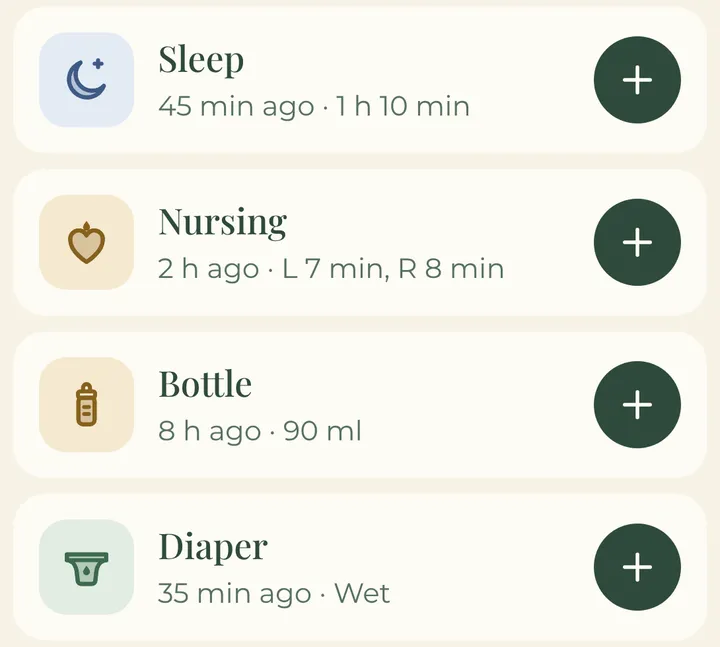
In the middle of the night, it's hard to tell whether wake-ups are getting more frequent or just feel that way. A few days of notes can show when your baby wakes, how long they're up, and whether a feed was part of it. That's what BabyTides will help with: feeds and sleep logged in a tap or two, and day and week reports with day and night sleep averages. It won't tell you why your baby woke, but it gives you and your pediatrician a clearer picture.
For what's typical at each age, see how much babies sleep and when babies start sleeping through the night.
Keep reading
 Sleep · 3–6 monthsThe 4-month sleep regression: what's really changingHow baby sleep matures around 4 months, what the evidence does and doesn't show, and what may help.
 Sleep · 0–12 monthsWhen do babies start sleeping through the night?What sleeping through really means, what research shows in the first year, and what may help longer stretches.
 Sleep · 0–24 monthsHow much should my baby sleep?What's typical from the newborn weeks to age 2, why night waking is normal, and what may help.
BabyTides is coming to iPhone and Android. Join the waitlist and we'll email you when it opens.
Join the waitlistSources
- American Academy of Pediatrics, HealthyChildren.org. Getting Your Baby to Sleep. Updated June 4, 2024.
- American Academy of Pediatrics, HealthyChildren.org. Sleeping Through the Night. Updated September 5, 2013.
- NHS. Helping your baby to sleep. Reviewed January 28, 2025.
- NHS Best Start in Life. Your baby's sleep patterns. Last modified March 27, 2026.
- American Academy of Pediatrics, HealthyChildren.org. Stages of Newborn Sleep. Updated September 18, 2013.
- American Academy of Pediatrics, HealthyChildren.org. Reversing Day-Night Reversal. Updated November 2, 2009.
- American Academy of Pediatrics, HealthyChildren.org. Separation Anxiety & Sleeping Trouble in Young Children. Updated August 25, 2022.
- American Academy of Pediatrics, HealthyChildren.org. How to Keep Your Sleeping Baby Safe: AAP Policy Explained. Updated September 11, 2026.
- American Academy of Pediatrics, HealthyChildren.org. Sleep Apnea in Children: Detection & Treatment. Updated April 24, 2024.
Sources checked October 22, 2026. Sources 1, 2, 3 and 7 rechecked October 27, 2026.