 BabyTides™
Join the waitlist
Crying · 0–24 months
Baby crying: what's normal, what helps and when to call
All babies cry, and in the first months it can feel like a lot. This page brings together what the AAP, NHS and CDC say about how much crying is typical, how to respond, how to look after yourself, and when crying is a reason to call, with links to our more detailed guides.

Crying is normal, and it changes with age
The CDC describes crying, including long periods when a baby can't be comforted, as normal behavior in infants, and says it is worse in the first few months of life [4]. The AAP says newborns routinely cry 1 to 4 hours a day [2].
According to the NHS, the amount of crying tends to increase from around 2 weeks of age and eases at around 3 months [1]. The AAP describes a similar pattern: crying usually peaks at about 3 hours a day by 6 weeks, then drops to 1 or 2 hours a day by 3 to 4 months [3].
The NHS says hard-to-settle crying happens most often in the afternoon and evening, when parents are usually most tired [1], and the AAP describes a fussy period that tends to fall between 6 p.m. and midnight [3]. The AAP says about one in five babies develops colic [3].
BabyTides app · coming to iPhone and Android
Know when they last slept and fed
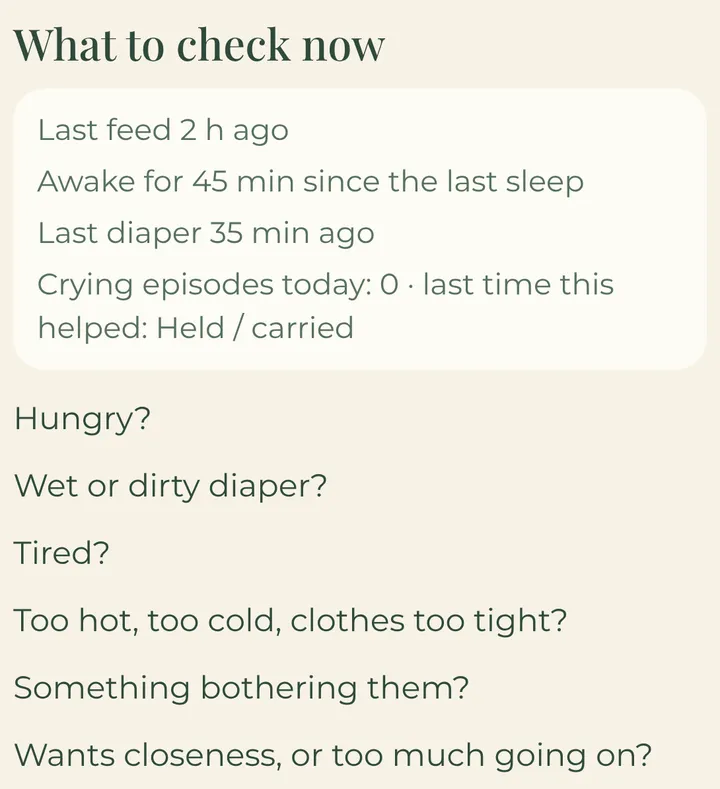
Log sleep, feeds and diapers in a tap. When the crying starts, BabyTides shows what to check first, from your own log.

- Sleep and feeds
- What to check
- Weekly summary
Want paper for now? Print our free newborn log, no sign-up needed.
Not in the App Store or Google Play yet. We’ll email you when it opens.
Responding to your baby
The AAP recommends responding promptly to crying in the first few months. It says you can't spoil a young baby with attention, and that babies whose calls for help are answered cry less overall [2].
The NHS lists common reasons babies cry, including hunger, a wet or dirty diaper, tiredness, wanting a cuddle, wind, being too hot or too cold, boredom and too much stimulation [1]. Its soothing ideas include holding your baby close and moving gently, steady background noise, gently stroking their back, a ride in the stroller or car, and a warm bath, though it notes a bath upsets some babies [1]. If your baby falls asleep in a car seat, the NHS says to move them to a firm, flat surface to sleep as soon as possible [1].
The AAP also notes that all babies cry, often without any apparent cause [2].
When you need a break
The NHS says not to be ashamed to ask for help [1]. It suggests talking to a friend, your health visitor or your GP, and lists Cry-sis, a free UK helpline on 0800 448 0737, open 9am to 10pm, seven days a week [1].
If no one else can look after your baby for a while and the crying is making you stressed, the NHS suggests putting your baby somewhere safe, such as their crib or stroller, leaving the room and taking a set time to calm down, for example 10 minutes, before going back [1]. The AAP says that if no other adult can take over, it's acceptable to place your baby on their back in a safe spot and step out of the room briefly [3]. The CDC suggests checking on your baby every 5 to 10 minutes and calling a friend, relative or neighbor for support [4].
Never shake a baby, however frustrated you feel [1, 2]. The AAP says shaking can cause blindness, brain damage or death [2, 3].
When to call your pediatrician
The AAP suggests talking to your pediatrician to make sure long crying isn't related to a serious medical condition [3]. The NHS says to trust your instincts if something seems wrong [1].
Call your pediatrician (in the UK, your GP or NHS 111) if your baby:
- shows signs of being unwell, such as a high temperature [1]
- isn't interested in feeding [1]
- is crying constantly and you can't console or distract them, or the cry doesn't sound like their normal cry, which the NHS says can be a sign of illness [1]
- is crying and can't be soothed, and has a rectal temperature of 100.4°F (38°C) or higher [2]
Call 911 (999 in the UK) or your local emergency number if your baby has a seizure; has blue, gray, pale or blotchy skin, lips or tongue (on brown or black skin, check the palms or soles); is unresponsive, floppy or harder to wake than usual; has difficulty breathing, is breathless or is breathing very fast; is vomiting forcefully and often; has a high or low temperature; has a rash that doesn't fade when pressed; or hasn't had a wet diaper in the past 8 hours [1].
More on baby crying
- Why is my baby crying? Common reasons and what helps
- Crying in the first weeks: the normal crying curve
- Why does my baby cry every evening?
- Fever in babies: when to call the doctor
- Growth spurts and cluster feeding: what's normal?
- Are the Wonder Weeks real? What the research says
- When the crying won't stop: coping and staying safe
- Teething: signs and what helps
Writing it down helps
The NHS suggests keeping a record of how often and when your baby cries. It says this can help your health visitor or GP look for a cause, and help you see when you need extra support [1].
BabyTides is being built to make that easier. You'll be able to log feeds, sleep and diapers in a tap, and when your baby is crying, open a calm checklist of common reasons to check, with your recent log next to it. It can't tell you why your baby is crying.
Keep reading
 Crying · 0–4 monthsWhy does my baby cry every evening?What's typical, what doctors mean by colic, what may help, and when to call your pediatrician.
 Crying · 0–24 monthsAre the Wonder Weeks real? What the research saysWhere the fussy-week calendar comes from, what later studies found, and what the AAP and NHS say.
 Crying · 0–4 monthsCrying in the first weeks: the normal crying curveHow much young babies cry, what studies found about the 6-week peak, and when crying is a reason to call.
BabyTides is coming to iPhone and Android. Join the waitlist and we'll email you when it opens.
Join the waitlistSources
- NHS. Soothing a crying baby. Reviewed April 22, 2026.
- American Academy of Pediatrics, HealthyChildren.org. Responding to Your Baby's Cries. Updated February 20, 2025.
- American Academy of Pediatrics, HealthyChildren.org. Colic Relief Tips for Parents. Updated April 22, 2024.
- Centers for Disease Control and Prevention. About Abusive Head Trauma. Updated May 16, 2024.
Sources checked October 27, 2026.