 BabyTides™
Join the waitlist
Sleep · 3–24 months
Baby sleep regression: ages, signs and what may help
“Sleep regression” is a phrase parents use when sleep becomes less settled after a more predictable period. This guide explains the term, looks at age-related questions, and covers practical support and when to seek advice.
Looking for an earlier change? Read our guide to the 4-month sleep regression.
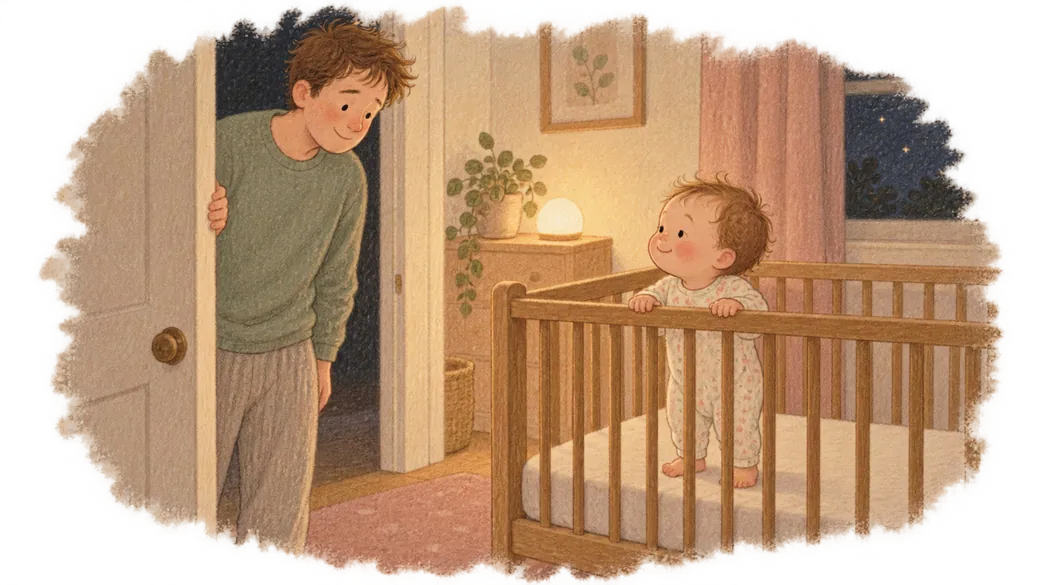
Quick answers
What do parents mean by a sleep regression?
Parents use this phrase for more waking or harder-to-settle naps after a more settled period. These changes do not tell you their cause. See other reasons sleep changes, including hunger, discomfort and illness. [1, 2]
At what ages can sleep change?
Sleep patterns change as babies grow, and each baby has their own pattern. The ages below organize common questions; they are not a timetable every baby follows. [1, 2] Find your age-related question.
How long can a change in sleep last?
The sources cited here do not establish one duration for every “sleep regression.” What is happening matters more than a countdown. If your baby seems unwell or you are worried, contact your pediatrician rather than waiting for a phase to end.
What may help?
A simple, soothing bedtime routine may help your baby settle. Be ready to adjust routines as your baby grows. [2] Read what may help and keep safe sleep central to any changes.
Find your sleep question
Choose the question that fits your family. These ages are navigation aids, not a schedule of regressions or a diagnosis.
| Your question | Read next |
|---|---|
| Sleep changed around 4 months | Our dedicated 4-month guide |
| Waking more around 8–10 months | New skills and the limits of the evidence |
| Sleep changed around 12 months | Night waking and other possible explanations |
| Toddler sleep around 18 months | Naps and separation anxiety |
| What can we do tonight? | Practical support and safe sleep |
| My baby seems unwell | When to seek medical help |
Baby sleep regression ages: questions by age
Use these age labels to find information, not to predict a setback.
Around 4 months
For the earlier months, our guide to the 4-month sleep regression explains changing sleep patterns, the limits of the evidence and practical support.
Around 8–10 months
The studies discussed below link some sleep changes to learning new skills, rather than to a fixed month. Read crawling, walking and sleep for the findings and their limitations. [5–8]
Around 12 months
A birthday alone does not explain changed sleep. See the evidence on night waking across the first year and consider other reasons sleep changes. [1, 2, 9, 10]
Around 18 months
For toddler sleep questions, read about changing naps and separation anxiety. These sections describe patterns, not a guaranteed 18-month regression. [4, 11, 12]
What parents mean by a sleep regression
Parents use the phrase for a stretch of nights when a baby who had been sleeping fairly well starts waking more, or fights naps that used to be easy. It's an everyday phrase rather than a medical one. The NHS and AAP pages on baby sleep we drew on don't use it [1–3], and neither does a large 2026 study of new skills and sleep [8].
What the NHS does say is that your baby's sleep pattern will change as they grow, and that it can feel as though every time you've settled into a routine, it changes again [1]. For the earlier and better-known one, see the 4-month sleep regression.
Crawling, walking and sleep
This is where the research is most direct. Most of it comes from a small number of research groups, and the studies are small, so it's best read as a pattern rather than a rule.
- Crawling. In a study of 107 babies aged 5 to 8 months, babies who had started crawling had more trouble falling asleep and woke more often at night than babies who hadn't [5]. A later study followed 28 babies from 5 to 11 months with movement monitors and found that the rise in disrupted sleep was linked in time to when each baby started crawling [6].
- Walking. A study of 78 babies found that learning new motor skills came with a temporary rise in night waking and in movement during sleep, and that babies slept worse than usual for their age group while learning to walk [7].
- Smaller than it feels. A 2026 study of 245 families, using data from a commercial baby monitor, found that around most new skills babies had more awake time than usual, but not more night wakings [8]. The effects it measured were small [8].
Babies reach these skills at different ages. None of these studies describes a regression that arrives at a set age [5–8].
Separation anxiety
The AAP says that beginning in the second half of the first year, separation anxiety can cause many nights of disrupted sleep [4]. During this stage, which can last several months, a child may wake several times and cry anxiously for one or both parents [4].
The AAP says separation anxiety usually fades around the second birthday, and that until it does, your child may need reassurance several times, night after night [4].
Naps are changing, too
A study that followed 172 children found that two daytime naps were well established by 9 to 12 months, and a single nap by 15 to 24 months [12]. A 2020 review of studies on children's napping, drawing on a large Swiss study, reports that taking two or more naps a day dropped off sharply between 12 and 18 months [11]. Fewer than 2.5% of children stopped napping altogether before age 2 [11].
A day with one nap instead of two is a different day, and some parents notice nights change around the same time. We didn't find a study that measured whether dropping a nap disturbs night sleep, so we can't say whether it does.
Other reasons sleep changes
Not every rough patch is about development. The NHS says teething pain and hunger can disturb a baby's sleep [1]. It also lists growth spurts, teething, illness, hunger and being too hot or too cold among the things that can affect or disturb sleep [2].
If your baby seems unwell, or the change comes with a fever, see our guides to fever and teething.
Night waking across the first year
Two studies that followed babies through the first year give a wider view:
- In a study of 118 babies, mothers reported that wake-ups went down on average from 3 to 6 months and went up again at 9 months [9]. The study relied on mothers' questionnaire reports, which the author notes can't objectively confirm changes in sleep [9].
- In a study of 52 babies in New Zealand, the share whose sleep the researchers classed as self-regulated rose from 56% at 6 months to 72% at 12 months. Between those ages, 21% of babies moved into that group and only one baby moved out [10]. The authors didn't describe a dip at 8 to 10 or 12 months. They note the sample was modest and came from one country [10].
Put together: waking at night is still common through the first year, and many babies' sleep does get more settled by 12 months, though not in a straight line [9, 10]. The AAP notes that it's normal for a 6-month-old to wake during the night and then go back to sleep [3].
What may help
The AAP has a few suggestions for babies 4 months and older [3]:
- Bed when drowsy. The AAP suggests putting babies to bed when they're drowsy, rather than waiting until they're asleep [3].
- A pause before you go in. The AAP suggests not rushing in to soothe a crying baby, because babies need time to learn to fall back asleep on their own [3]. You can, of course, go to your baby when they need a feed, a diaper change, or comfort because they're sick [3].
The NHS says a simple, soothing bedtime routine may help a baby settle, for example a bath, a fresh diaper, a story, dimmed lights and a lullaby [2]. It also advises being ready to change routines as your baby grows [2].
During separation anxiety, the AAP says your child may need reassurance several times, night after night [4]. For daytime goodbyes, it suggests telling your child matter-of-factly when you're leaving and keeping the goodbye short, and notes that separations are easier to accept as part of a predictable routine [4].
Hard nights are hard on parents, too. The NHS suggests sleeping when your baby sleeps, asking a partner to help, or, if you're on your own, asking a friend or relative to stay for a few days so you can get some sleep [2].
Safe sleep still comes first
New skills change what's safe in the crib. The AAP recommends placing babies on their back for every sleep until they're 1 year old [3], stopping swaddling when your baby looks like they're trying to roll over, and keeping soft objects and loose bedding out of the sleep space [13]. If you bring your baby into your bed to feed or comfort them, the AAP says to place them back in their own sleep space before you go to sleep [13].
When to talk to your pediatrician
Get help right away
Call your local emergency number (911 in the US; 999 in the UK) if your baby stops breathing or cannot be woken. Get emergency help for serious breathing difficulty or blue, gray or unusually pale skin. Do not wait for a sleep phase to pass. [15, 16]
The AAP advises telling your pediatrician right away if your child snores often, has problems breathing during the night, or seems sleepy during the day [14]. If your baby seems unwell, or you're worried about how they're sleeping, call your doctor. For a fever, follow the age-specific advice in our fever guide; do not assume it is a regression.
Writing it down helps
When nights suddenly get harder, it's hard to tell whether it's a phase, a new tooth or something else. A week or two of notes can show when your baby wakes, how long the longest stretch is, and how naps are changing. That's what BabyTides will help with: sleep logged in a tap, and day and week reports that show how sleep is changing. It can't tell you why your baby is waking, but it gives you and your pediatrician a clearer picture.
For what's typical at each age, see how much babies sleep. For the common reasons babies wake, see why babies wake at night.
BabyTides app · coming to iPhone and Android
See your baby’s sleep, day by day
Log naps and nights in a tap. The weekly summary shows how much sleep there was and when, so changes are easier to see.

- Sleep log
- Notes
- Weekly summary
Want paper for now? Print our free newborn log, no sign-up needed.
Not in the App Store or Google Play yet. We’ll email you when it opens.
Keep reading
 Sleep · 3–6 monthsThe 4-month sleep regression: what's really changingHow baby sleep matures around 4 months, what the evidence does and doesn't show, and what may help.
 Sleep · 0–12 monthsWhen do babies start sleeping through the night?What sleeping through really means, what research shows in the first year, and what may help longer stretches.
 Sleep · 0–24 monthsWhy does my baby wake up so often at night?The usual reasons babies wake, from hunger to separation anxiety, what may help, and when to call your pediatrician.
BabyTides is coming to iPhone and Android. Join the waitlist and we'll email you when it opens.
Join the waitlistSources
- NHS Best Start in Life. Your baby's sleep patterns. Last modified March 27, 2026.
- NHS. Helping your baby to sleep. Reviewed January 28, 2025.
- American Academy of Pediatrics, HealthyChildren.org. Getting Your Baby to Sleep. Updated June 4, 2024.
- American Academy of Pediatrics, HealthyChildren.org. Separation Anxiety & Sleeping Trouble in Young Children. Updated August 25, 2022.
- Scher A, Cohen D. Locomotion and nightwaking. Child: Care, Health and Development. 2005;31(6):685–691.
- Scher A, Cohen D. Sleep as a mirror of developmental transitions in infancy: the case of crawling. Monographs of the Society for Research in Child Development. 2015;80(1):70–88.
- DeMasi A, Horger MN, Scher A, Berger SE. Infant motor development predicts the dynamics of movement during sleep. Infancy. 2023;28(2):367–387.
- Waugh M, Berger SE. Infants' sleep supports the emergence and mastery of locomotor and linguistic skills. Developmental Psychobiology. 2026;68(5):e70187.
- Scher A. A longitudinal study of night waking in the first year. Child: Care, Health and Development. 1991;17(5):295–302.
- Henderson JMT, Blampied NM, France KG. Longitudinal study of infant sleep development: early predictors of sleep regulation across the first year. Nature and Science of Sleep. 2020;12:949–957.
- Staton S, Rankin PS, Harding M, et al. Many naps, one nap, none: a systematic review and meta-analysis of napping patterns in children 0–12 years. Sleep Medicine Reviews. 2020;50:101247.
- Weissbluth M. Naps in children: 6 months–7 years. Sleep. 1995;18(2):82–87.
- American Academy of Pediatrics, HealthyChildren.org. How to Keep Your Sleeping Baby Safe: AAP Policy Explained. Updated November 24, 2026.
- American Academy of Pediatrics, HealthyChildren.org. Sleep Apnea in Children: Detection & Treatment. Updated April 24, 2024.
- NHS. Sudden infant death syndrome (SIDS). Emergency advice checked November 27, 2026.
- NHS. When to get urgent medical help for babies and children under 5. Checked November 27, 2026.
Sources checked October 29, 2026. Study details (sources 5 to 12) checked October 25 and 26, 2026.